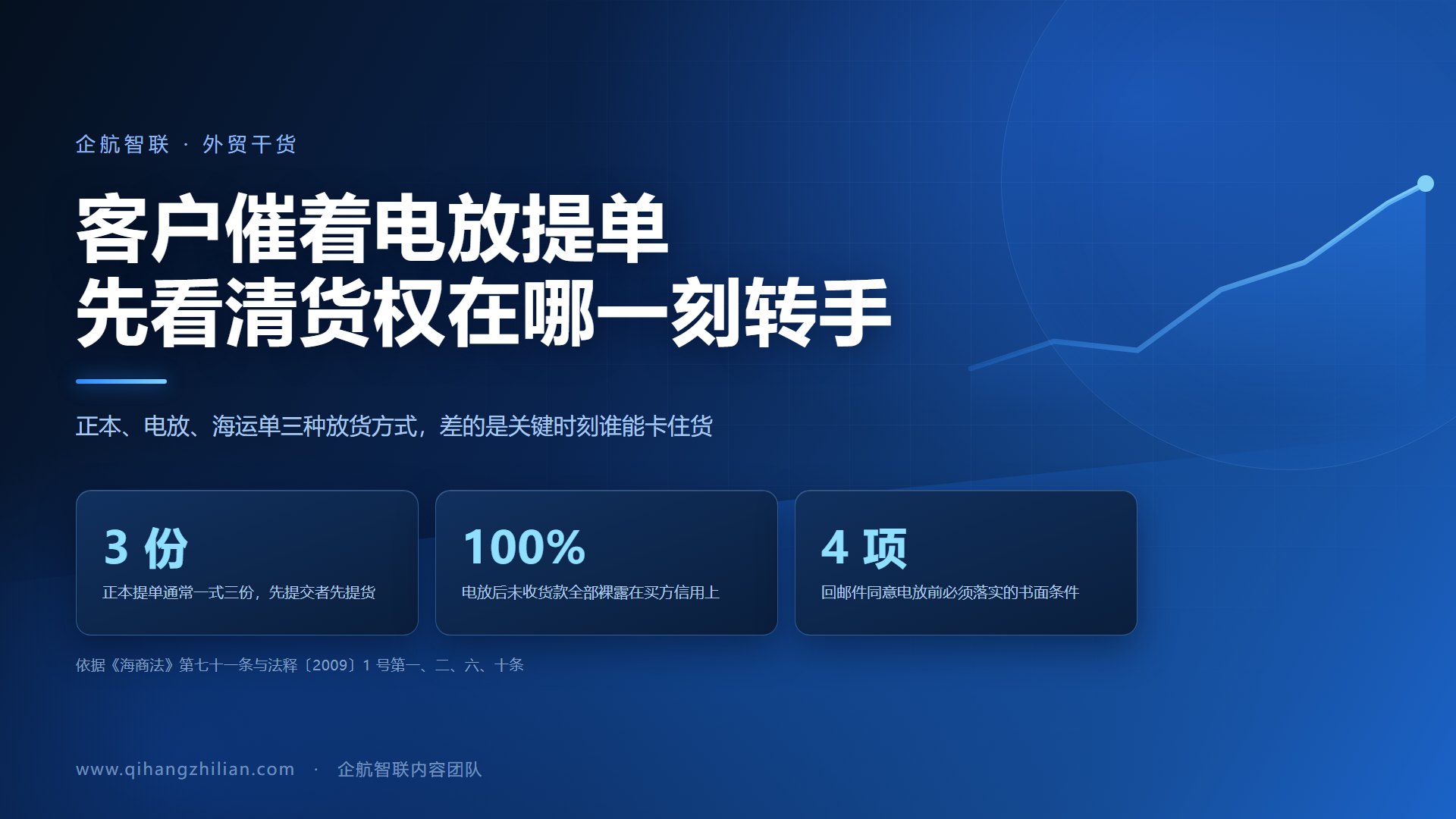
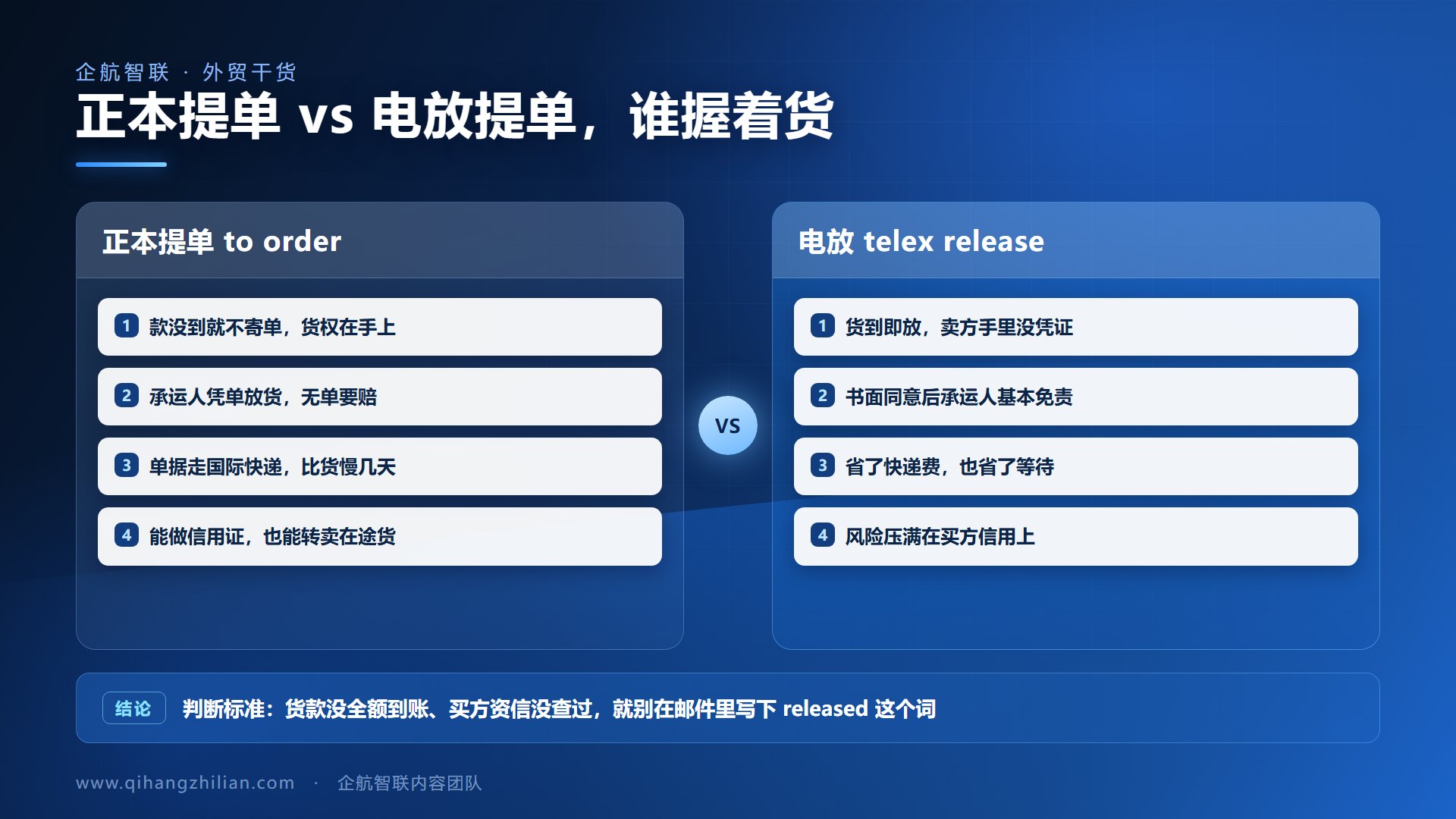
Core Conclusion: Telex release is not "sending the bill of lading faster" but actively canceling the "release against document" gate. According to Article 71 of the Maritime Code, the bill of lading is the document by which the carrier undertakes to deliver the goods; your written consent to telex release tells the carrier to release the goods without examining the original, leaving only the buyer's credit as protection for who takes delivery and whether payment is recovered. The judgment criteria are only two: whether payment has been received and whether the buyer's credit has been verified—if either condition is not met, do not write "released" in your email.
This issue is more worth discussing now as cargo space is becoming more available. According to data from the Shanghai Shipping Exchange on November 20, the Shanghai Containerized Freight Index (SCFI) stood at 3,503.78 points, down 68.55 points from the previous period, a decrease of approximately 1.9%. As freight rates decline, factories are more willing to accept urgent orders, shipping schedules are increasing to compete for cargo, and the timing of cargo arrival becomes harder to predict, increasing the likelihood of documents not keeping up with the cargo.
I. What is released in telex release is not a document, but the key to controlling the cargo
A bill of lading has three identities: proof of the carriage contract, receipt for the goods received by the carrier, and document for claiming the goods. The first two can be replaced if lost, but the third cannot be recovered. The telex release process is: the shipper submits a telex release application or letter of indemnity, the carrier reclaims the original or marks "surrendered," and then notifies the destination port agent to release the goods against the consignee's identity. After this step, you don't even have a piece of paper in your hand.
More importantly, how is liability allocated? Article 2 of the Supreme People's Court's Provisions on Several Issues Concerning the Application of Law in Cases of Delivery of Goods Without Original Bill of Lading provides a strong legal basis for the holder of the original bill of lading: if the carrier delivers goods without the original bill of lading causing losses, the holder can claim compensation from the carrier. Article 6 clarifies the scope of compensation—calculated as the value at loading plus freight and insurance, and Article 4 specifies that the limitation of liability under Article 56 of the Maritime Code does not apply. As long as you hold the original bill of lading, the carrier will not dare to release the goods improperly, and cannot reduce compensation based on "per package limits".
The Maritime Court of Shandong Higher People's Court has put it more bluntly: the carrier can only be exempted from liability in three situations—goods unclaimed and handed over to customs, mandatory delivery to port authorities under destination port laws, and the seller's own permission for delivery without the original bill of lading. The third situation is exactly telex release: the moment you agree, your path to pursuing the carrier is basically blocked, leaving only the buyer to pursue.
II. Select Release Method Based on Amount and Credit, Then Consider Customer Urgency
Release method is not an emotional issue, but a financial exposure issue. Below are five tiers categorized by order amount and buyer credit, with the third column showing the actual amount of money you have at risk for this shipment:
| Scenario | Recommended Release Method | Maximum Unpaid Exposure | Mitigation Measures |
|---|---|---|---|
| New client, single order under $50,000 | Release telex after full payment | 0 | Verify bank slip, not screenshots |
| New client, single order over $50,000 | 30% deposit + release telex after balance payment | 70% of order value | Export credit insurance or bank guarantee |
| One year cooperation with no overdue records | Can release telex, retain 20% final payment against B/L copy | 20% of order value | Check litigation and payment history for each shipment |
| Letter of credit payment | Only original B/L, no telex release | 0, documents held by bank | Present documents per UCP600 |
Focus on only two columns in this table: the third column shows your actual risk exposure, and the second column shows your available options. If the third column exceeds the gross profit of this order, the nature of this transaction changes—you're not selling goods, but providing an unsecured loan to the buyer.
III. Before Replying to Emails, Finalize These Four Items in Writing
Agreeing to telex release isn't impossible, but it shouldn't be done based solely on "the customer is in a hurry." Complete the following items before drafting your email:
- Obtain a buyer credit report, focusing on litigation records for payment defaults in the last 12 months, not just registered capital.
- Request a stamped payment commitment letter from the buyer stating "full payment of remaining balance within X working days after telex release," and verify the signatory is listed in the registered directors.
- Send telex release application only to the carrier with a copy to your freight forwarder, clearly stating "for this shipment only, this container only, this amount only".
- Calculate the ratio of unpaid amount to this shipment's value. If it exceeds gross profit, modify terms first; only consider telex release if the ratio is within 20%.
- If export credit insurance is already in place, first confirm the buyer is covered and the limit includes this shipment amount before deciding whether to release.
The most commonly overlooked item is the third point. Many factories' telex releases are verbally agreed by sales staff via WeChat and relayed to the shipping company by the freight forwarder. If issues arise, they can't produce written authorization, while the carrier maintains records of your "consent to release goods".
IV. When Clients Rush: The Costs of Four Different Response Methods
The same request "Could you telex release the documents first?" can lead to four different outcomes depending on your response. Understand the costs before choosing your reply:
| Response Method | How to Phrase in Email | Client Acceptance | Our Remaining Risk |
|---|---|---|---|
| Telex release after payment | We will release once the balance is confirmed in our account. | Medium, acceptable to regular clients | Low, but may lose the order |
| Deposit + Telex release | Telex release against 30% deposit and a bank guarantee for the balance. | High | Medium, with 70% still exposed |
| Switch to Sea Waybill | We suggest a Sea Waybill with your company as consignee. | Medium | Medium-high, goods can be claimed with ID only |
The first and fourth columns are a pair: the softer your response, the higher the fourth column. The second row is truly worth mastering—deposit plus bank guarantee. Clients may think they need to visit their bank, but this is the only approach that gives them face while protecting 70% of the payment. As for not responding and forcing the client to resolve it themselves, this looks safe but is in fact the most expensive: once the buyer abandons the goods, detention fees, storage fees, and return shipping costs all fall on the shipper, and no insurance policy will cover these losses.
V. Ready-to-use English Response
The following response combines both "rejection" and "solution" in one email. Simply replace the bracketed content before sending:
Subject: Re: Telex release request – PO [PO number] / Container [container number]
Dear [client name],
Thank you for your email. We understand the container is now inside its free-time window at [port].
We are not able to authorise telex release at this stage, because the balance of USD [amount] under invoice [invoice number] has not yet been received. Under Article 71 of the Chinese Maritime Code, a bill of lading is the document against which the carrier undertakes to deliver the goods. Once we release without the original, that protection is gone for both of us.
We can act on either of the following today:
1. Confirm the balance by T/T; the original B/L goes out by courier the same day.
2. Arrange a bank guarantee for the balance; on receipt we release within one working day.
Please confirm which option you prefer and we will move immediately.
Best regards,
[sender name] | [company name]
This response is more effective than a simple "Sorry, we cannot" because it does three things: first, acknowledges the facts (goods have arrived, free time is running); second, provides legal basis (citing maritime law, turning rejection into policy rather than attitude); finally, offers two actionable solutions that can be implemented immediately. The client wants the goods, not an argument—when a clear path is provided, their frustration typically subsides.
VI. Frequently Asked Questions
1. I've already approved telex release—can I reverse it?
Basically, no. Once the telex release instruction reaches the carrier, it has the right to release the goods against identification. You cannot prevent delivery that has already occurred. At this point, you should immediately secure evidence—correspondence emails, telex release application, bill of lading copy—and then claim payment from the buyer according to the sales contract, rather than approaching the shipping company.
2. If the client provides a telex release letter of indemnity, is it safe?
No. A telex release letter of indemnity is issued to the carrier to reassure them and release them from liability. It does not impose any additional payment obligation on the buyer. It only serves as proof that "I authorized the release," which is precisely the evidence of the carrier's exemption from liability.
3. The client says their country requires telex release—what should I do?
Request written documentation. Have the carrier or destination port agent provide a statement specifying which regulation and article requires delivery to port authorities. If you cannot obtain this, handle it as a standard commercial requirement—collect payment first, or switch to a sea waybill and have the carrier confirm the release conditions in writing.
VII. Conclusion
Telex release itself is not wrong—the mistake is treating it as a "customer service action" rather than a "credit extension action." On the day goods arrive at port, you have only two choices: hold the original bill of lading and wait for payment, or clearly calculate the financial risk before releasing. Prepare in advance for different amount tiers, written terms, and English responses. Even if the client is in a hurry, you won't need to make a 30-day decision in ten minutes.
Qihang Zhilian Content Team · Enabling Chinese Manufacturing to Set Sail Globally · For customized domestic and international market expansion solutions, call 180-0327-6609