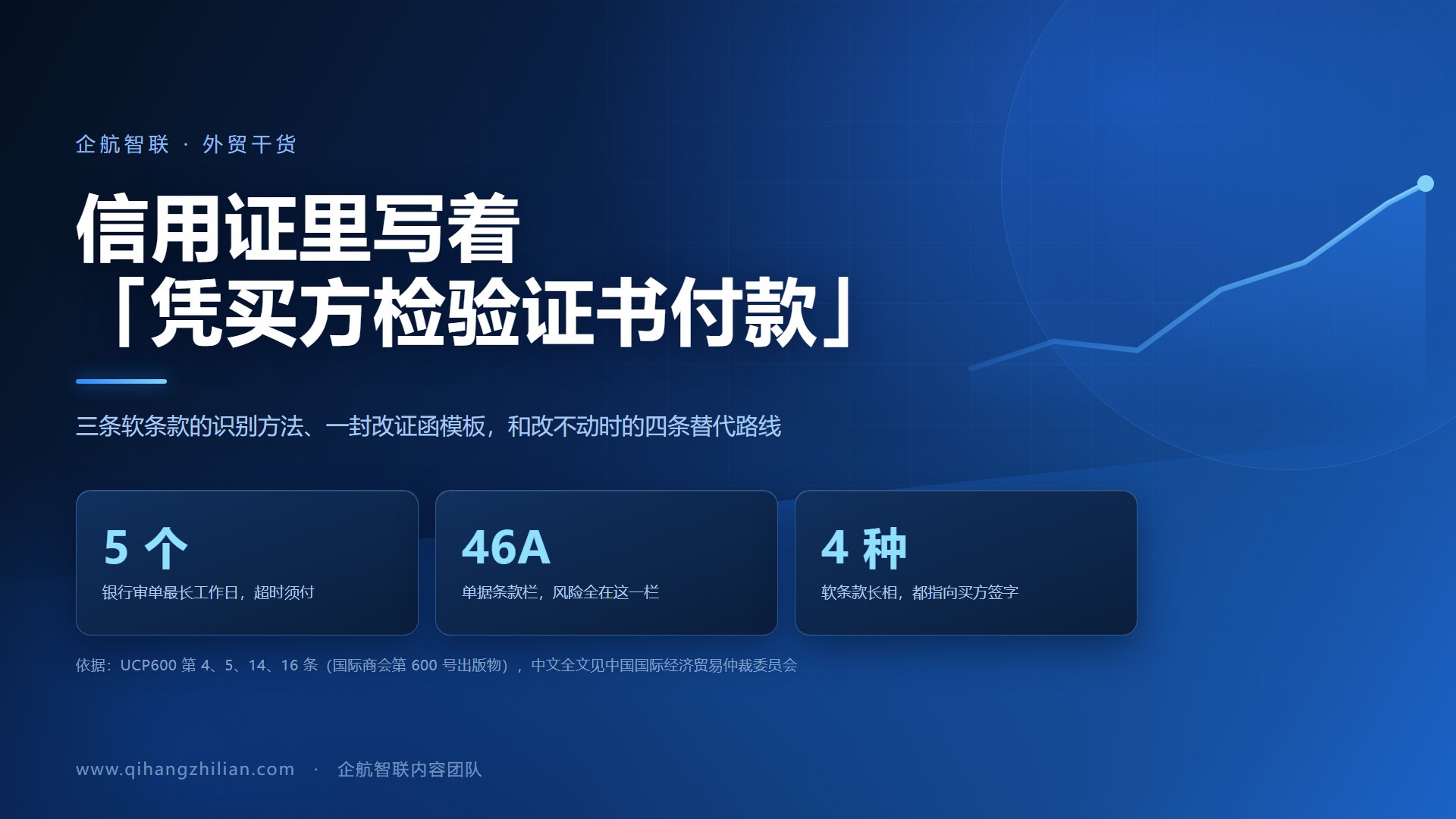
Core Conclusion: The protection a letter of credit gives you covers only one thing—banks examine documents, not goods. Therefore, any clause that grants the buyer the authority to issue a specific document effectively downgrades the letter from "bank payment" to "payment only upon buyer's approval". The standard is straightforward: go through the list of documents one by one, and if any document is specified as "issued by the applicant or their authorized representative," it must be amended. If three such clauses exist, don't ship the goods. UCP600 Article 14(b) gives banks only 5 banking days to examine documents; failure to raise discrepancies within this timeframe means they must pay (Full Chinese text of UCP600). The real bottleneck isn't slow banks, but your inability to obtain that piece of paper with the buyer's personal signature.
These two points are often overlooked together. UCP600 Article 4(a) stipulates that a letter of credit and the sales contract are separate transactions, with the bank having no relation to or being bound by the contract (ICC Trade Finance); Article 5 adds: banks deal in documents, not goods. This is your protective moat—buyer dissatisfaction with the goods can't reach the document examination stage. But once a clause requires "a buyer-signed inspection certificate," their opinion gains legitimacy through that document, effectively filling the moat they themselves created.
I. Soft Clauses Aren't "Harsh"—They Shift Payment Control Back to the Buyer
Banks perform only one function during document examination: verifying whether the documents appear consistent with the letter of credit terms. They have neither the ability nor the intention to judge whether the goods meet specifications. Thus, any clause that requires the bank to rely on the buyer's approval to release payment effectively downgrades the letter to a credit sale arrangement.
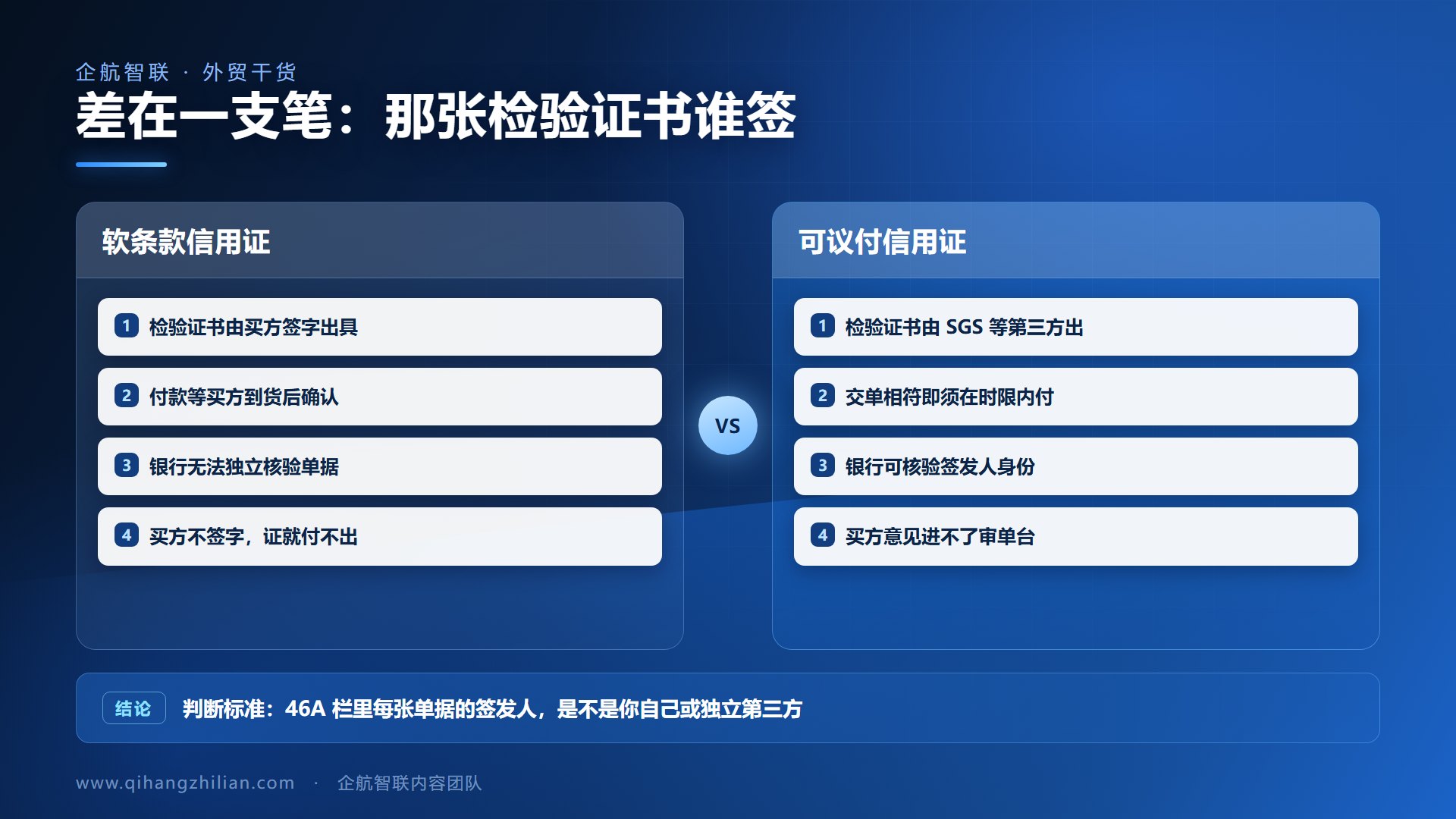
Industry professionals call these "soft clauses," which come in only four forms: documents issued by the buyer (inspection certificate issued by the applicant); payment contingent upon buyer confirmation after arrival; activation clauses specifying "subject to the applicant obtaining import license," making it impossible to determine if the letter is active even when you hold it; and signature comparison, where only the buyer holds the signature sample. Their common feature isn't harshness, but control remaining with the buyer, who gains a legitimate, evidence-free reason to refuse payment—they don't need to prove defects in the goods; simply by refusing to sign that document, they can prevent the bank from making payment.
II. Three Rules That Must Be Changed: Categorize by Issuer
Copy each clause from field 46A (Documentary Requirements) of the letter of credit, categorize them by issuer, and the risk level becomes immediately apparent:
| Original Clause (Excerpt) | Document Issuer | Can Bank Verify Independently | Risk Level |
|---|---|---|---|
| Inspection certificate issued by the applicant | Buyer | No | High |
| Payment upon buyer's confirmation of quality after arrival | Buyer | No | High |
| Signature must match specimen held by issuing bank | Buyer | No (requires comparison with reserved signature sample) | High |
| Inspection certificate issued by SGS or Bureau Veritas | Independent Third Party | Yes | Low |
Focus only on the fourth column: if "High" appears, it's not a pricing issue that can be resolved with price reductions. The last row also demonstrates that soft clauses are not unavoidable—the same shipment can specify that the inspection report be issued by SGS, BV, or CCIC, where the issuer is an independent third party that the bank can verify, making it impossible for the buyer to renege. During negotiations, don't argue about "whether to inspect," but rather "who inspects."
III. How to Request an Amendment: A 120-Word English Amendment Letter
Amendments don't require renegotiation—one email is sufficient. The key is to mention only terms, not emotions, and translate "I don't trust you" into "the bank requires verifiable documents for document examination." Below is the original text you can directly copy, replacing bracketed information with your own:
Dear [client name],
Thank you for L/C No. [LC number] issued by [issuing bank]. Before we arrange production, we would like to request one amendment under UCP600 Article 10.
Field 46A currently requires an inspection certificate issued by the applicant. As the issuing bank cannot independently verify a document signed by the buyer, this clause makes the credit conditional on the applicant's discretion rather than on document compliance. We respectfully request that it be replaced with:
"Inspection certificate issued by SGS or Bureau Veritas, covering quantity, packing and visual defects, one original plus one copy."
We will book the inspection at our own cost and share the report with you before shipment. Kindly confirm the amendment by MT707 so that we can start production this week. All other terms remain unchanged.
Best regards,
[your name]
This approach works because it does three things: cites UCP600 Article 10 to place the request within a regulatory framework; bases the reasoning on "the bank cannot independently verify," which effectively speaks for the client's bank; and proactively covers the inspection cost and promises to share the report before shipment, eliminating concerns. The final sentence "All other terms remain unchanged" is particularly important—amendments often create new problems if not handled carefully.
To effectively implement this, follow this sequence:
- On the day you receive the letter of credit, verify three points: the 46A document list, the 31D expiry date and place of presentation, and the spelling of the beneficiary's name in field 59. Any errors must be corrected before production begins.
- List all documents "issued by the applicant" in a single email to the client—don't mention them separately in three different messages, as each amendment request requires a separate banking process.
- Request that the client send the amendment via MT707 and have the advising bank issue a confirmation of receipt. Verbal agreements, email confirmations, or screenshots are not considered valid.
- Add a clause to your contract or PI stating: "Soft clauses must be amended within 5 working days after the letter of credit is issued; otherwise, the delivery date will be postponed." Do not schedule production or book shipping until the amendment is confirmed.
IV. What to Do When the LC Cannot Be Amended: Four Alternative Routes
Some clients truly cannot amend the LC—not because they're unwilling, but because their bank charges a fee and requires internal approval for each amendment, and their purchasing department refuses to sign. In such cases, don't push back—change your approach. The opening strategies, acceptance levels, and risks of these four methods differ significantly:
| Method | How to Propose | Client Acceptance | Risks You Assume |
|---|---|---|---|
| Insist on LC amendment | Amend only field 46A, leave the rest unchanged | Moderate; most long-term clients accept | Delivery extension during amendment period, potential order loss |
| 30% deposit + 70% against copy of B/L | "The deposit covers raw materials, with balance payment against copy of B/L" | High; buyer only needs bank approval for the deposit | Payment may still be delayed at the copy of B/L stage |
| Add confirmation or export credit insurance | "Please have your bank add confirmation" or self-purchase insurance | Low; buyer must pay additional confirmation fees | Confirmation fees and insurance premiums eat into profits |
| Partial LC + partial advance payment | "70% via LC, 30% advance payment" | High; buyer's financial pressure is minimized | Documents still processed per LC, soft clauses remain effective |
The second and fourth options are the most commonly implemented solutions in practice. The trade-off is converting risk into price—the credit period concession should be factored into the quotation, not offered as a discount. The first option is only worth insisting on when gross profit can cover the amendment cost and the client relationship is worth maintaining. For the third option, understand the boundaries clearly: export credit insurance covers the buyer's credit risk, not operational errors like "document discrepancies."
V. Discovery After Shipment: Two Time Limits That Can Save You
Only discovering soft clauses after shipment has occurred? Don't accept the loss yet—there are two key provisions in the rules. UCP600 Article 14(b): The issuing bank, confirming bank (if any), or nominated bank each have a maximum of 5 banking days from the date of presentation to claim discrepancies, after which they can no longer do so. Article 16(c): When rejecting a presentation, banks must list all discrepancies in a single notice and cannot first cite one discrepancy, wait for correction, then cite another.
Therefore, within 24 hours of receiving a rejection notice, do three things: read it word for word and count how many discrepancies it lists; if additional discrepancies appear later, counter-reference Article 16(c); simultaneously request the client to provide written instructions accepting the discrepancies. But have realistic expectations—client acceptance doesn't obligate the bank to pay.
VI. Frequently Asked Questions
1. The client is a long-term partner we've worked with for five years—should we still amend the soft clauses?
Yes, but the focus isn't fraud prevention—it's process protection. While long-term clients do have a lower probability of issues, once their quality control department changes personnel or they face tight downstream payments, that "buyer's signature" document becomes the most convenient delay tool. Your tone can be soft, but the clauses must be removed.
2. How much does it cost and how long does it take to amend one LC field?
Charged per field. Foreign issuing banks typically charge several dozen dollars per field, while domestic issuing banks charge in RMB—check their specific fee schedule. The process generally takes 2-5 business days. Fees are usually borne by the party requesting the amendment, so there's no need to proactively state "I'll cover the costs" in your correspondence.
3. The bill of lading has already been telex released—can it still be recovered?
Very difficult. Telex release means the cargo rights have already been transferred. At this point, your only leverage is the contract and correspondence, not the LC. Therefore, the sequence should always be: confirm documents can be presented before releasing cargo; checking the B/L ten minutes before shipment is more useful than litigation afterward.
VII. Conclusion
Soft clauses are not exclusive to scammers; most of the time, they're just a line in the buyer's template that no one examines closely. Your task is not to judge the other party's character, but to go through each item in field 46A and ask "Who signs this document." If the person who signs is them, have it amended; if it can't be amended, change the payment method; if neither is possible, calculate the profit on this order assuming you won't get paid, and then decide whether to accept it.
Qihang Zhilian Content Team · Empowering Chinese Manufacturing to Set Sail Globally · For customized export customer acquisition solutions, call 180-0327-6609