Core Conclusion:The documentation retention period for export tax rebates has doubled—starting January 1, 2026, the retention period for supporting documents has been extended from 5 to 10 years, with documents required to be filed within 15 days of declaration. There is no transition period. The standard is simple: can you retrieve the three documents (purchase and sale contract, shipping documents, and customs declaration authorization) for any shipment after January 2026 within one business day? If not, your filing system will not withstand an audit. Non-compliant documents will require adjustment of the original declaration, calculated at the 13% rebate rate—for 1 million RMB in exports, that means 130,000 RMB in rebates must be returned. See Article 45 of the full text of the State Taxation Administration Announcement No. 5 of 2026 for details.
While tax rebates are being processed faster, documentation requirements are growing longer. The State Taxation Administration reports that in the first half of 2026, export tax rebates for enterprises increased by 7.7% year-on-year, with the average processing time for normal export rebates controlled within 6 working days (reported by Securities Times); for Class I and Class II export enterprises, the average processing time for normal rebates has been reduced to within 3 working days (reported by China Taxation News). Faster refunds mean more frequent declarations and a higher volume of documents—accumulating geometrically over ten years. Many factories' filing systems are still stuck in 2015.

I. From Five to Ten Years: The Extra Five Years Multiply Document Volume, Not Just Filing Cabinets
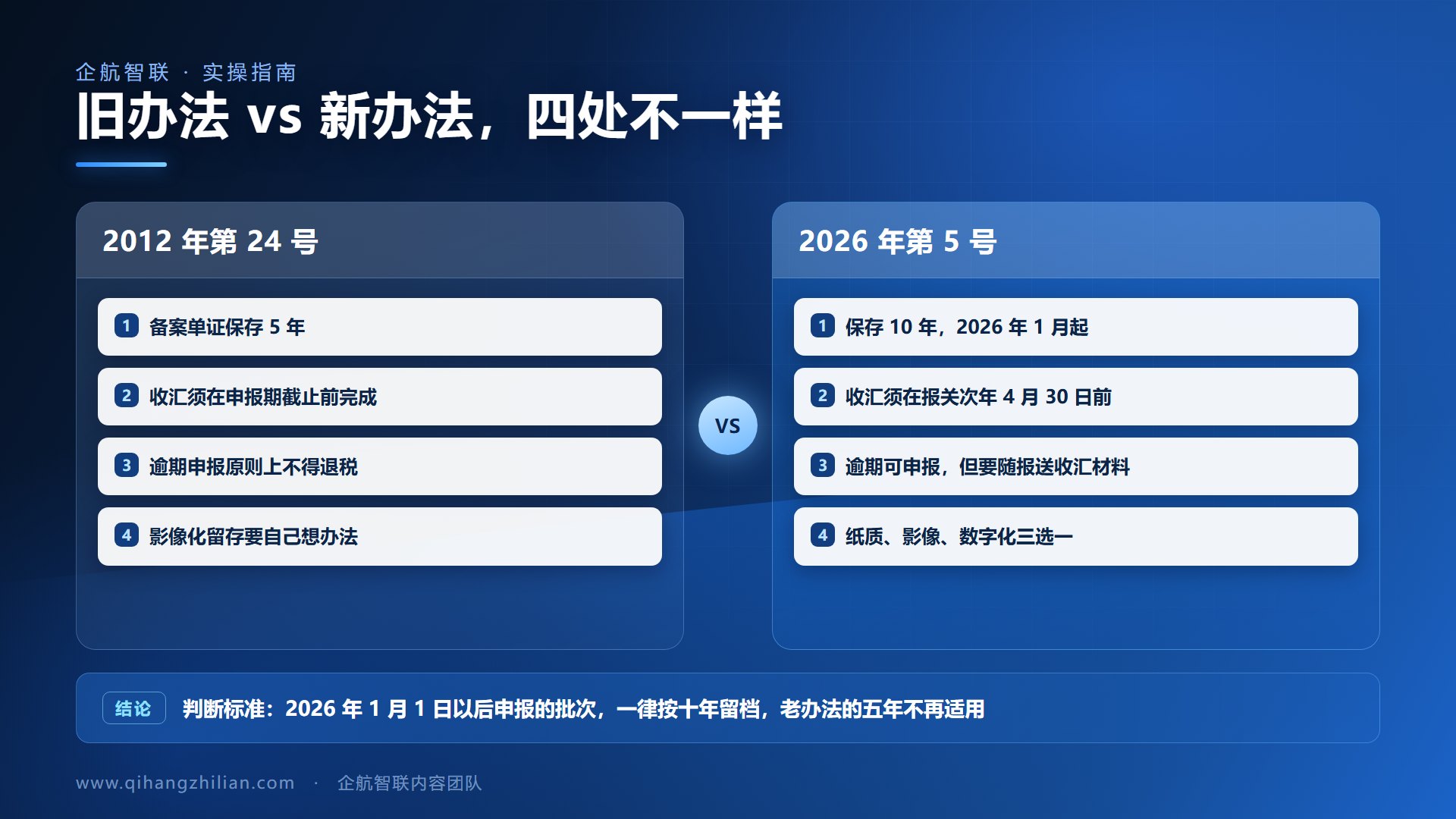
The previous regulation was the 5-year period from Announcement No. 9 of 2022, while the new method in Article 45 extends it to ten years, also requiring retention within 15 days of declaration, cataloging in declaration order, and specifying storage methods. The latter is key—it's not just about "having" the documents, but about "sequential order, cataloging, and verifiability": the tax bureau doesn't want a box of papers, but the ability to trace through batch numbers to find the three required documents for any specific shipment.
Let's calculate the volume based on document volume to determine whether you should continue using filing cabinets:
| Annual Export Shipments | 5-Year Retention | 10-Year Retention | Additional Documents |
|---|---|---|---|
| 100 shipments | 2,000 documents | 4,000 documents | 2,000 documents |
| 300 shipments | 6,000 documents | 12,000 documents | 6,000 documents |
| 1,000 shipments | 20,000 documents | 40,000 documents | 20,000 documents |
Calculation basis: 4 documents per shipment (contract, bill of lading, customs declaration authorization, and customs agent invoice). Look at the last column: a factory with 300 annual export shipments will have 6,000 additional documents over ten years—nearly 48,000 pages at 8 pages per document. Filing cabinets can't hold them all. The issue isn't whether you can buy more cabinets, but whether you'll be able to find what you need three years from now.
II. What are the three types of documents: A review of Article 45
The new regulations only list three types, one less than the 2012 old regulations which included the "Shipping Order" for export goods—no longer listed separately since 2022 and not reinstated in the new regulations, so don't ask your customs broker to supplement it. The three types are:
- Sales Contracts: Export contracts, foreign trade comprehensive service contracts, foreign trade enterprise purchase contracts, and purchase contracts for production enterprises to purchase non-self-produced goods for export. Supplementary agreements under the same contract are also included.
- Transport Documents: Ocean bill of lading, air waybill, railway bill, goods carrier documents, postal receipts and other documents issued by the carrier; domestic transport invoices for which you pay the freight; international freight forwarder service fee invoices.
- Customs Brokerage Authorization Documents: Customs brokerage authorization agreement, and the agency customs brokerage service fee invoice issued by the entrusted customs brokerage unit. If you handle customs brokerage yourself, this category may not be required.
- Transaction Method Exceptions: For transaction methods like FOB, EXW where the buyer pays the freight, the absence of domestic transport invoices is not considered missing documents, as Article 45 explicitly states "except when taxpayers do not have corresponding filed documents due to the characteristics of the transaction method."
The responsible parties for the three types of documents differ: contracts are in your possession, transport documents should be obtained from the freight forwarder, and customs brokerage authorization documents should be obtained from the customs broker. The latter two are not in your filing cabinet, so what you need to establish is a checklist of "who will provide what to me within how many working days."
III. Two dates to remember: 15 days after declaration, April 30 of the following year after customs declaration
The retention period is 15 days, calculated from the date of declaration, not the date of customs declaration—once the declaration is submitted, the file must be complete; you cannot wait for the tax bureau to ask before scanning the missing documents. The foreign exchange collection deadline has been changed in Article 48 to "before April 30 of the year following the customs declaration date," which is easier to calculate than the old regulation's "before the deadline of the declaration period," but it is a strict constraint for orders with long payment terms.
If the contractually agreed payment date is already later than April 30 of the following year, Article 48 provides an exception: collect payment according to the contractually agreed period, but not later than 36 months from the customs declaration date. If the contract does not clearly specify the final payment date, this exception cannot be applied. Additionally, Article 49, Item 1 clarifies: if declared after April 30 of the following year, the foreign exchange collection materials must be submitted together with the declaration.
IV. Three retention methods: Paper, imaging, digitalization—choosing the wrong one requires rework
Article 46 allows for paper-based, imaging, or digital retention. If choosing paper-based, the storage location must be indicated in the directory. All three methods are compliant, but their condition will differ greatly after ten years:
| Retention Method | Implementation | Corresponding Clause | Most likely points of failure after ten years |
|---|---|---|---|
| Paper Filing | Bound into volumes by declaration batch, with storage location indicated in the directory | Article 46 (Paper-based) | Relocation, warehouse dampness, no one knowing where the documents are after the handler leaves |
| Imaging Filing | One folder per declaration, PDFs named "Customs Declaration Number + Document Type" | Article 46 (Imaging) | Missing pages in scanning, lack of cross-seal on scanned copies; requiring individual stamping when converting to paper format |
| Digital Filing | ERP or electronic filing system, bound to declaration batch numbers and searchable | Articles 42, 46 | System version changes, lost account permissions, backups only on one computer |
The standard is not in the method but in "deliverability": when the tax bureau requires converting imaging or digital documents to paper format, you must be able to provide them with stamps and signed statements confirming consistency with the original data (Article 47). Therefore, electronic systems must be able to export paginated PDFs with one click—many ERPs can store images but cannot export bound files, and you will still have to rework them during inspection.
V. Ready-to-use English email: Requesting documents from freight forwarder and customs broker
Two of the three types of documents are not in your possession. Send this email directly to your freight forwarder, replacing the customs broker section with the corresponding documents:
Subject: Documents needed for our export VAT refund file – B/L [bill of lading no.]
Dear [forwarder name],
Under the export VAT refund rules effective 1 January 2026, we must keep the supporting documents for ten years from the filing date. Please send PDF scans to [email] within five working days:
1. Bill of lading, full set, showing shipper, consignee, port of loading, on-board date and freight terms;
2. Customs brokerage agreement signed by both parties for shipment [invoice no.];
3. Your brokerage service invoice issued to [company name], with our unified social credit code printed on it;
4. Domestic transport invoice for the leg [factory] – [port], if the freight was paid by us.
If any item cannot be issued, please reply in writing with the reason, so we can file an alternative document instead.
Best regards,
[your name] / [title] / [company] / [phone]
The four items correspond to the three types of documents required under Article 45, requesting no more than necessary. The specific requirements for shipper, consignee, port of loading, on-board date, and freight terms are to verify that all required elements are complete. The five-day deadline and requirement for written explanation if documents cannot be issued establishes an evidentiary chain for alternative documentation.
VI. Frequently Asked Questions
1. Are electronic scans considered certified documents?
Yes. Article 46 allows for the use of paper, imaging, or digital formats. The prerequisite is that they can be printed and stamped when requested (Article 47), so scans must be clear enough to identify stamps and dates.
2. Can lost documents be replaced?
They can be replaced with other materials, but not fabricated. Article 45 allows substitution with "other documents with similar content or function," with notation in the catalog. Never create false bills of lading—providing false certified documents is handled under Article 70 of the Tax Collection and Administration Law, as referenced in Item 2 of Article 60.
3. Without a domestic transport invoice under FOB terms, will the documents be considered incomplete?
No. Article 45 explicitly excludes taxpayers from providing corresponding documents "due to the characteristics of the transaction method." However, you must be able to prove the transaction method: the trade terms in the contract, invoice, and bill of lading must be consistent. Avoid having FOB in the contract but freight prepaid on the bill of lading.
4. Should old documents from before 2026 still be retained?
Handle them according to the previous five-year requirement. Only batches declared after January 1, 2026 are subject to the ten-year retention. Expired old files need not be recreated, but do not destroy documents from 2021 onward, as they may remain the sole evidence during verification. The response from the Guangxi Tax Bureau on June 18, 2026 confirms this approach.
VII. Conclusion
Only one number and one date have changed. But ten years is enough to replace two document clerks, move a factory, and change systems. The solution is not to buy larger filing cabinets, but to establish a process documenting "who will provide which document to whom within how many working days," rather than relying on individual memory.
Enterprise Navigation Intelligence Content Team · Enabling Chinese Manufacturing to Set Sail Globally · For customized domestic and international customer acquisition solutions, call 180-0327-6609