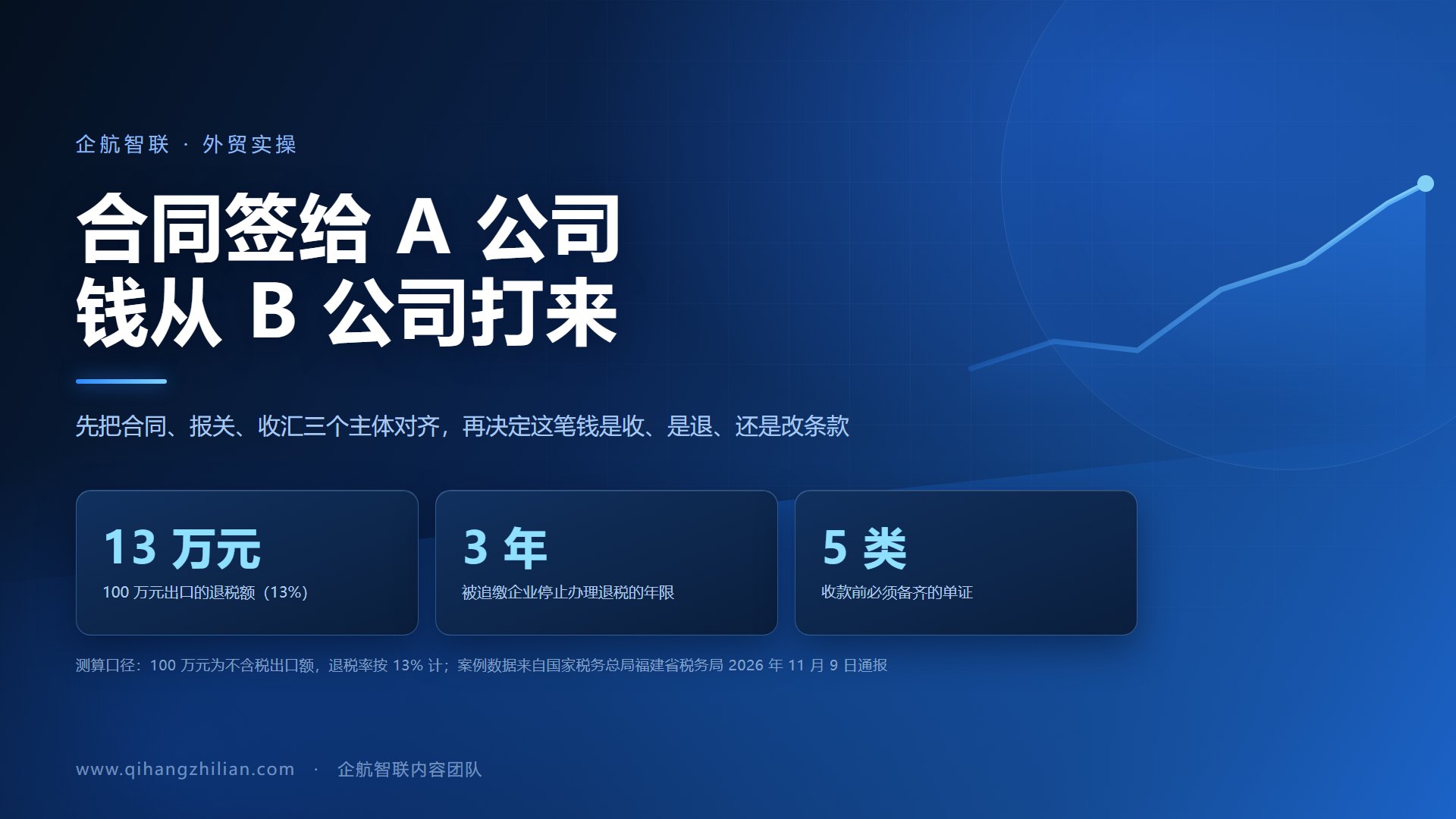
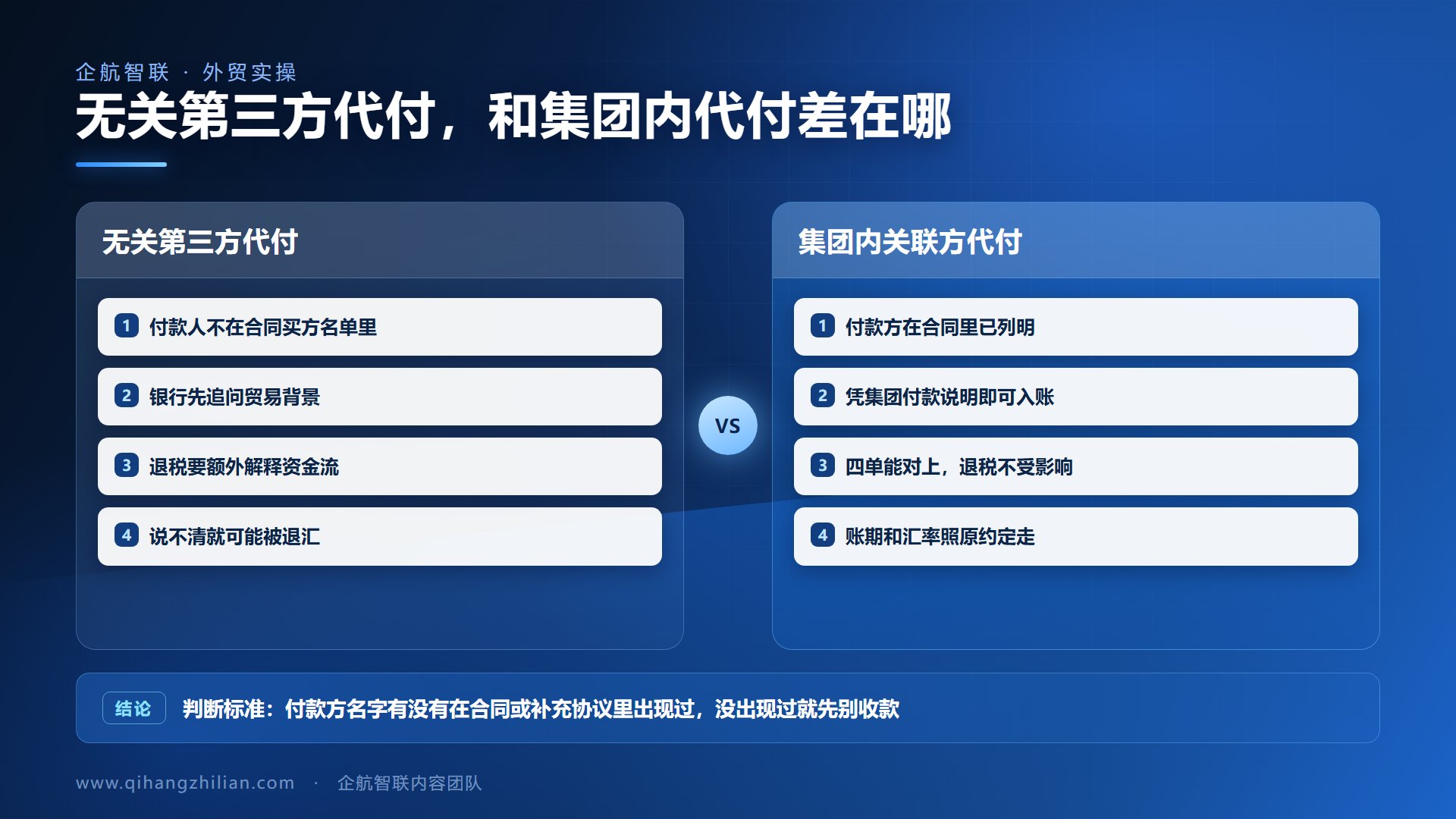
Key Conclusion: When the contract buyer is Company A but the remitter is Company B, whether you can accept the payment depends not on your relationship but on whether three parties align: the contracting party, the customs declaration party, and the payment recipient. The State Administration of Foreign Exchange has clearly stated that enterprises must handle foreign trade exchange payments according to the principle "whoever exports receives the exchange." When the payer and customs declaration party don't match, a substitute payment explanation must be provided. If this cannot be provided, the payment may be returned and tax refunds denied. There's only one criterion: has the payer's name appeared in the contract or supplementary agreement? If not, don't accept the payment—amend the contract first.
This issue has become particularly sensitive this year as fund flows have become an entry point for inspections. On November 9, 2026, the Fujian Provincial Tax Bureau of the State Taxation Administration reported that three foreign trade enterprises in Quanzhou fabricated business transactions, purchased invoices through third parties, recycled funds, and engaged in false exchange settlements, defrauding 13.2294 million yuan in export tax rebates. The full amount was recovered and their export tax rebate privileges were suspended for three years. Such cases often don't start with invoices but with mismatched payments. Let's calculate the cost: for a 1 million yuan tax-free export with a 13% tax rebate rate, the rebate amount is 130,000 yuan—this is the money that "mismatched payers" could potentially block.
I. Three Parties, One Line: The Contracting Party, Customs Declaration Party, and Payment Recipient
Foreign trade involves three identities that are often used interchangeably but are examined separately when issues arise. The contracting party is the buyer who signs and stamps the Sales Contract. The customs declaration party is the domestic consignor/consignee on the customs declaration form. The payment recipient is the Remitter on the bank statement.
The State Administration of Foreign Exchange is straightforward: Article 15 of the "Implementation Rules for the Administration of Foreign Exchange in Trade of Goods" requires enterprises to handle foreign trade exchange payments according to "whoever exports receives the exchange, whoever imports pays the exchange," with the handling party responsible for collection and payment in agency import/export transactions. Whoever's name is used for export should receive the payment, regardless of how many years you've cooperated or how internal group accounts are adjusted.
Banks conduct authenticity verification: if payment doesn't match the export, they have the obligation to investigate, and the consequences fall on the foreign trade company.
II. Four Payment Scenarios, Only Two Allow Safe Receipt
Examining common scenarios based on whether the customs declaration party and payment recipient match reveals significant differences in tax rebate outcomes for the same 1 million yuan export:
| Payment Scenario | Customs Declaration & Payment Recipient | Normal Tax Rebate Possible | 130,000 Yuan Rebate | Additional Consequences |
|---|---|---|---|---|
| Payment by the contract buyer | Match | Yes | Normal receipt | None |
| Payment by affiliated group company, specified in contract | Match | Usually yes | Normal receipt | Provide supplementary group payment explanation |
| Payment by unaffiliated third party, not specified in contract | Mismatch | Requires supplementary documents for determination | May be lost | Bank returns payment, 1-2 month delay |
| Receipt to personal account, exchange through underground banking | <="border px-3 py-2">Complete mismatchNo | Lost | Involves foreign exchange evasion, maximum fine of 30% of illegal amount |
Looking at columns three and four is sufficient: the first two scenarios secure the 130,000 yuan rebate. The third scenario depends on whether documents can be supplemented. The fourth scenario doesn't just lose tax rebates—unauthorized change of foreign exchange purpose and evasion can incur fines of up to 30% of the illegal amount. The Quanzhou case involved full recovery plus a three-year suspension of tax rebates, which is more damaging than fines.
III. If You Must Accept Payment, Prepare Five Documents First
If the client insists on third-party payment, don't rush to agree or refuse. Complete these five steps before deciding whether to accept:
- Retrieve the original Sales Contract and verify the buyer's name and address against the payment account name provided by the client—compare character by character, not abbreviations or short forms.
- Request a stamped substitute payment explanation from the client, specifying the relationship between the substitute payer and the buyer, payment amount, and corresponding PI or PO number.
- Report the "domestic consignor/consignee" on the customs declaration form according to the actual exporter—don't change the heading to accommodate the payer, as this would create a party mismatch.
- Cross-reference amounts and parties across the contract, invoice, customs declaration form, and bank statement—provide explanations for any discrepancies, even small ones.
- Start with a small amount for the first substitute payment, such as 10% of the order amount. Only proceed with full production after confirming bank receipt and normal verification.
After completing these five steps, you can answer most follow-up questions. If any question cannot be answered, hold off on accepting the payment—keeping the funds in your account for two extra weeks is much cheaper than having the payment returned and undergoing investigation for two months.
IV. What to Do When Negotiations Stall: How to Approach the Three Options
The same question "Can the payer be changed" can be phrased in four different ways, each creating a completely different impression on the client:
| Solution | How to Approach the Client | Client Requirements | Outcome |
|---|---|---|---|
| Direct payment from the buyer | Explain that the bank requires the remitter to match the buyer on the contract and request payment from the contracting entity | Change payment account | Cleanest documentation, tax rebate unaffected |
| Group payment + payment statement | Accept third-party payment but require a stamped statement explaining the relationship between companies and payment authorization | Provide Group Payment Statement | Acceptable by most banks, filed with documentation |
| Three-party payment agreement | Include payment obligation transfer in a supplementary agreement, signed by all three parties | Signed by buyer, paying entity, and your company | Requires prior bank notification, agreement attached to tax rebate documents |
| Change settlement instrument | Use a letter of credit to lock the payment entity, where the applicant is the payer | Open LC and bear associated costs | Clearest fund flow but slower process |
The priority order is: first change the payer, then provide documentation, and finally change the settlement instrument. The first two options modify procedures; the third involves contract changes requiring client legal department approval; the fourth changes the entire transaction settlement method with the highest cost. The earlier you present "the remitter must match the contract buyer" as a bank requirement, the less likely the client will feel you are questioning their integrity.
V. Ready-to-Use English Payment Confirmation Email
This email can be used directly - just replace the bracketed information:
Subject: Payment Account Confirmation - PO [PO No.]
Dear [Name],
Before we schedule production for PO [PO No.], we need to confirm the paying party. Our bank requires the remitter to match the buyer named on the sales contract, or a signed third-party payment statement to be on file before the payment is credited.
Please confirm which of the following applies:
1. Payment will be made from the account of [Buyer Company], the contracting buyer.
2. Payment will be made by [Paying Entity]. In this case, please send us a statement on your letterhead confirming that [Paying Entity] is authorized to pay on behalf of [Buyer Company], together with the relationship between the two companies.
In both cases, please confirm that the consignee on the bill of lading remains [Buyer Company].
We will release the production schedule as soon as this is confirmed.
Best regards,
[Your Name]
[Company] | [Phone]
Three elements are intentionally designed: the beginning attributes the requirement to the bank to avoid defensive reactions; the middle offers two options rather than commands, leaving the choice to the client; the final clause locks the bill of lading consignee to prevent goods from being shipped to A, paid by B, but endorsed to C.
VI. Frequently Asked Questions
1. The client says their group makes payments through a Hong Kong company. Can we accept this?
Yes, but the relationship must be documented. Have the client provide a stamped statement explaining the affiliated relationship and payment authorization, and confirm that the bill of lading consignee remains the contract buyer. With these two points, banks typically process it as affiliated third-party payment, and tax rebates remain unaffected.
2. Will third-party payment affect export tax rebates?
It depends on whether the documentation aligns. Tax rebates require the contract, invoice, customs declaration, and receipt of foreign exchange to correspond to the same actual transaction. With a third-party payment statement, it's an explainable discrepancy; without it, the fund flow may be flagged as abnormal.
3. We've already received payment but discovered the payer is incorrect. What should we do?
Don't exchange the currency or rush to ship goods. Inform your bank on the same day, provide the client's confirmation letter and third-party payment statement. If the goods haven't been cleared by customs, changing the bill of lading is the least costly option. If already cleared, attach the statement to the tax rebate documents.
4. Is all this necessary for amounts of only a few thousand dollars?
Yes. Small amounts are more likely to be seen as test accounts. The first transaction might be a small test payment to confirm it can be received and verified before proceeding with larger orders.
VII. Conclusion
Third-party payment is not a moral issue but a documentation issue. When three parties align, you have a payment statement, and the four flows (goods, funds, invoices, and customs declarations) match in amount, this is just a regular payment. Relying on "the client said it's fine" requires ten times the effort during verification. Today, you can take three actions: review the payers for ongoing orders, prepare a third-party payment statement template, and include "the remitter must match the contract buyer" in your PI payment terms.
Qihang Zhilian Content Team · Empowering Chinese Manufacturing to Set Sail Globally · For customized export acquisition solutions, call 180-0327-6609