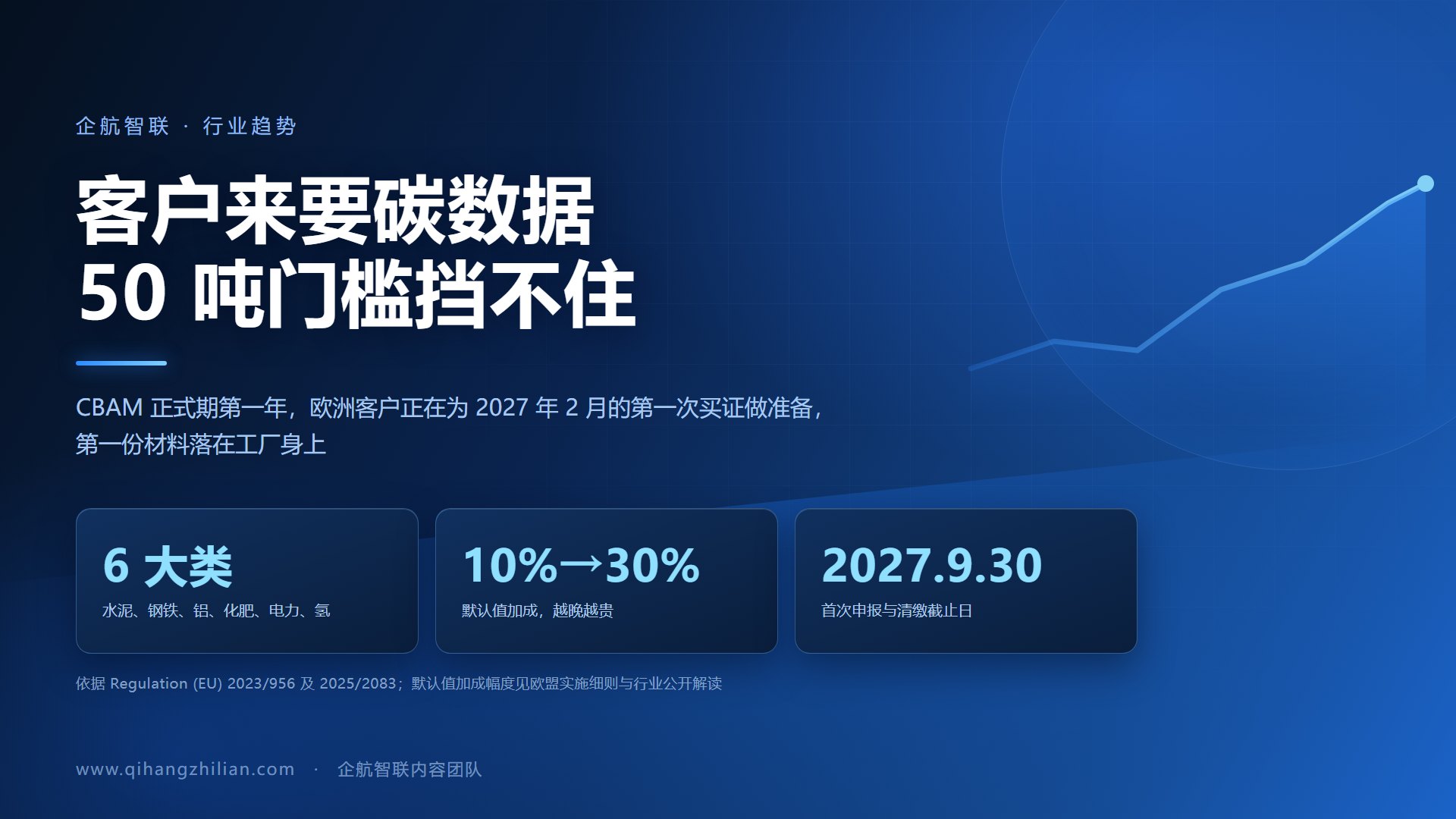
Core Conclusion: The CBAM 50-ton threshold refers to the EU importer's cumulative annual import volume, not the shipment quantity of this specific order—if a client combines several suppliers and exceeds 50 tons, you'll be responsible for providing the carbon emission data. If actual verified data cannot be provided, emissions will be calculated based on country-specific default values, which include progressive surcharges: 10% in 2026, 20% in 2027, and fixed at 30% from 2028 onward (China Steel News Network). Determination criteria: If an 8-digit CN code for your product falls within the six categories (steel, aluminum, cement, fertilizers, electricity, hydrogen), and the client's annual purchases of related goods from China may exceed 50 tons, you must establish emission records before the first settlement deadline of September 30, 2027. Without both data and records, address the data gap before discussing price increases.
Why address this now: CBAM has ended its transition period and entered formal enforcement as of January 1, 2026. The first reporting and settlement deadline for 2026 imports is September 30, 2027, with certificates available for purchase starting February 1, 2027 (EU Commission CBAM Official Information). European clients are currently preparing data for their first certificate purchases, and this data isn't in their possession—it's in your production facilities.
I. The 50-ton threshold applies to the client's annual cumulative imports, not this shipment
The regulations are clear: except for electricity and hydrogen, EU importers or their appointed indirect customs representatives must apply for authorized declarant status and fulfill reporting obligations only when their cumulative annual imports of CBAM-covered goods exceed 50 tons. The threshold applies to the importer and is calculated cumulatively.
Cumulative calculation means: a client may purchase similar products from you, another factory in Ningbo, and a Vietnamese supplier. If you only ship 20 tons annually but the client's combined total reaches 80 tons, they exceed the threshold, and you must still provide data for your 20 tons. "I only export 20 tons" is not a valid exemption—it merely shifts the responsibility back to the client, who doesn't have access to your electricity bills.
The two most common misconceptions are treating the 50-ton threshold as applying per shipment and calculating it separately for each supplier. A faster way to determine your obligation is to ask the client if they have an authorized declarant number—the deadline for importers to apply was March 31, 2026. If they have it, they will definitely request your data; if not, have them confirm via email that they don't exceed the threshold.
II. Default Values Are Not a Convenience, but a Penalty with Annual Price Increases
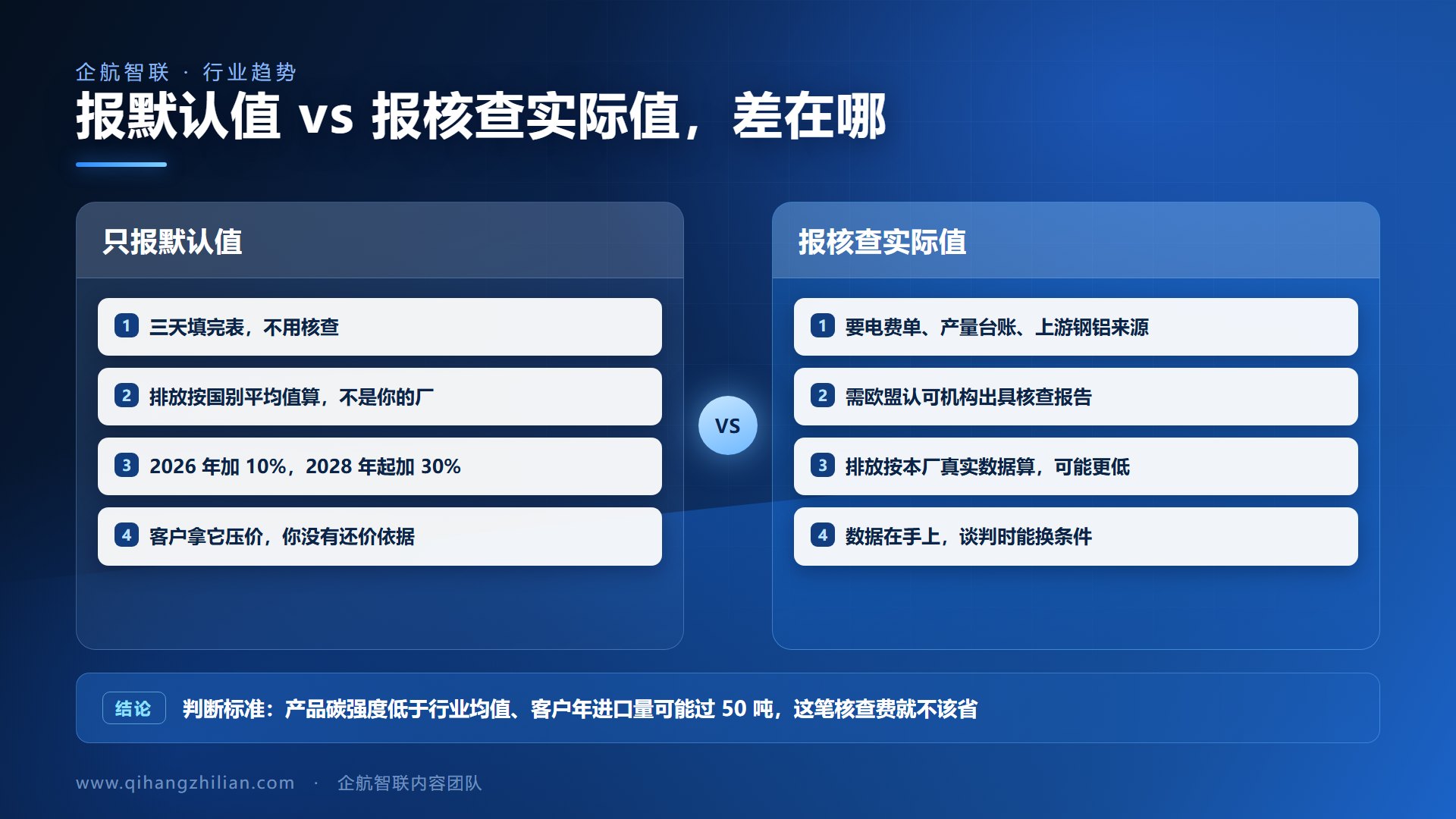
When verified actual emission data cannot be provided, rules permit estimation using country-specific default values. This may sound convenient, but it actually hides price increases: default values come with tiered surcharges, adding 10% in 2026, 20% in 2027, and a fixed 30% from 2028 onward. If the same batch of goods has its data submitted in 2028, its carbon emissions will be calculated as 30% higher.
Converting this to tonnage reveals the cost of delay (the table below assumes 1.8 tons of CO₂e per ton of steel for actual embedded emissions and 100 tons exported; certificate prices fluctuate with the EU quarterly average, which is not predicted in this article):
| Year | Default Value Surcharge | Additional Emissions for 100 Tons of Steel | Converted to CBAM Certificates |
|---|---|---|---|
| 2026 | +10% | 18 tons CO₂e | 18 certificates |
| 2027 | +20% | 36 tons CO₂e | 36 certificates |
| From 2028 | +30% | 54 tons CO₂e | 54 certificates |
Look at the third column, not the first. Percentages are abstract; the third column contains what customers' finance departments will calculate: 18, 36, 54 tons, meaning 18, 36, 54 certificates. Legally, this amount must be settled by importers, but commercially, it will always be passed back—through lower unit prices, compensation demands, or switching to a supplier that can provide data. Default values are not a convenience; they mean "if you don't have data, we'll calculate your emissions using the industry average plus a surcharge."
III. The Four Documents Clients Require—Missing One Means Reverting to Default Values
What clients or customs brokers typically send is an Excel sheet containing essentially four categories of information: product and coding, production boundaries and energy consumption, upstream steel and aluminum sources, and verification reports. The first three categories can be completed internally, but the fourth must come from an external agency.
- Self-check using CN codes: Each product exported to the EU corresponds to an 8-digit code. Create separate tables for products containing steel or aluminum, such as fasteners, aluminum profiles, steel structural components, and steel furniture frames.
- Gather 12 months of electricity and gas bills, breaking down energy consumption and fuel usage by the specific production line for the product—do not use total factory figures, as this would include unrelated workshops.
- Request three items from upstream suppliers: steel or aluminum grades, supplier names, and whether they have product carbon footprint reports. Include providing carbon emission data in quality clause attachments for new contracts.
- Maintain a ledger for each EU client: client name, authorized declarant number, CN code, annual tonnage, and data version. This table can save you when clients change procurement staff or customs brokers.
- Engage an EU-approved verification agency for a preliminary assessment to determine the gap before deciding whether to proceed with formal verification this year—the costs are not on the same scale.
Only the last of these five items requires payment; the rest can be completed within one week.
IV. The Three Response Approaches: Client Acceptance and Your Workload
When clients request carbon data, there are only three possible response approaches, each with different costs:
| Response Approach | What You Need to Prepare | Client Acceptance | Your Actual Cost |
|---|---|---|---|
| Provide only default values | Packing list, CN code, net weight | Accepted, but often leads to price reduction demands | Overstated emissions of 10%-30% for 2026-2028, deducted from unit price |
| Provide factory-level energy consumption data | 12 months of electricity bills, gas statements, production records | Partially accepted, often requires supplementary information | Risk of being deemed unverified and returned to default values |
| Provide verified product-level actual values | Above materials + upstream steel/aluminum sources + verification report | Highest acceptance, can be directly declared | Initial verification investment, with annual updates thereafter |
Look at the last column. Providing only default values requires the least effort, saving verification costs but costing you 10%-30% in emission differentials, which will be returned to you through price reductions. Providing verified actual values is most expensive but turns carbon emissions from a tool for price reduction into your bargaining chip, especially when your electricity structure is better than the industry average. The problem with the middle two approaches is that clients cannot declare unverified data, which will eventually revert to default values.
When first asked for data, you can directly use the following email (replace bracketed content with your information):
Subject: CBAM data for [product] — what we can provide
Dear [client name],
1. CN code and net mass for every 2026 shipment;
2. Electricity and gas consumption of the line producing [product], 12 months of meter readings;
3. Mill certificates and our steel/aluminium supplier list, with mill names and heat numbers;
4. A third-party verified product carbon footprint report — verification with [verifier name] has started, report expected in [month].
Until that report is issued, please use our installation-level actual data rather than the default values. We cannot accept a price adjustment calculated on default-value emissions, because the default value includes a mark-up that does not reflect how our plant actually runs.
Best regards,
[your name]
The key is in the last two paragraphs: break down what you can provide and when into a list, giving clients something to declare; then refuse price reductions based on default values, with the reasoning that the markup "does not reflect how our plant actually runs" — this is a loophole in the regulations themselves.
V. Expansion to 180 Downstream Product Categories in 2028: Factories That Don't Act Will Lose Most
The current list covers six basic product categories, with boundaries expanding: In July 2026, the European Commission's revised draft proposed including photovoltaic modules, battery energy storage, silicon materials, and cathode materials; on September 15, the European Parliament passed the expansion position, proposing to add approximately 180 steel and aluminum-intensive downstream products starting January 1, 2028 (Tai'an CCPIT). Based on EU COMEXT data calculations by some institutions, this expansion will affect China's exports of 18-22 billion euros.
The implication for factories is straightforward: the carbon content of a complete machine is approximately equal to the weight of its steel and aluminum multiplied by the upstream carbon intensity, plus processing energy consumption. In 2028, when asked "how much carbon is in this machine," half of the answer will be in the hands of steel mills.
VI. Frequently Asked Questions
1. I only export 20 tons of aluminum profiles, and my clients have never mentioned CBAM. Should I prepare?
You should prepare, but don't need to spend money immediately. First, do three zero-cost things: confirm whether your CN code is on the list, record the annual tonnage for each EU client, and save your factory's basic energy data. Once a client adds new suppliers causing the combined volume to exceed the threshold, you'll likely only have two weeks to submit the form.
2. Who actually pays for CBAM, and will it be directly deducted from the payment?
The legal taxpayer is the EU importer, who purchases certificates, clears payments, and bears any penalties. However, costs will be passed back through price reductions, compensation demands, or supplier changes. Clearly state in contracts: unit prices do not include CBAM certificate costs, and if clients require your party to bear these costs, separate negotiations are needed.
3. I already shipped goods in 2026. Is it too late to make up for it now?
It's not too late. Certificates will only be available starting February 1, 2027, with the first declaration and clearance due by September 30, 2027. However, 2026 data will be needed for next year's declaration, so you need to retroactively maintain records now.
4. How much does verification cost, and is it worth it?
Costs vary by product line and verification body, with no unified pricing. First conduct a preliminary assessment on your highest-volume product line to see the difference between actual and default values—the greater the difference, the more worthwhile verification is. For factories whose carbon intensity is already above industry average, focus on changing your electricity structure before considering verification.
VII. Conclusion
The easiest place to make mistakes isn't in unclear carbon calculations, but in misunderstanding responsibilities: the 50-ton threshold is the client's concern, while data provision is your obligation. Prepare the four required materials and include in your email that you won't accept price reductions based on default values. This transforms the dynamic from "giving clients what they want" to "what conditions you can negotiate in exchange for your data."
Qihang Zhilian Content Team · Enabling Chinese Manufacturing to Set Sail Overseas · For customized domestic and foreign market expansion solutions, please call 180-0327-6609