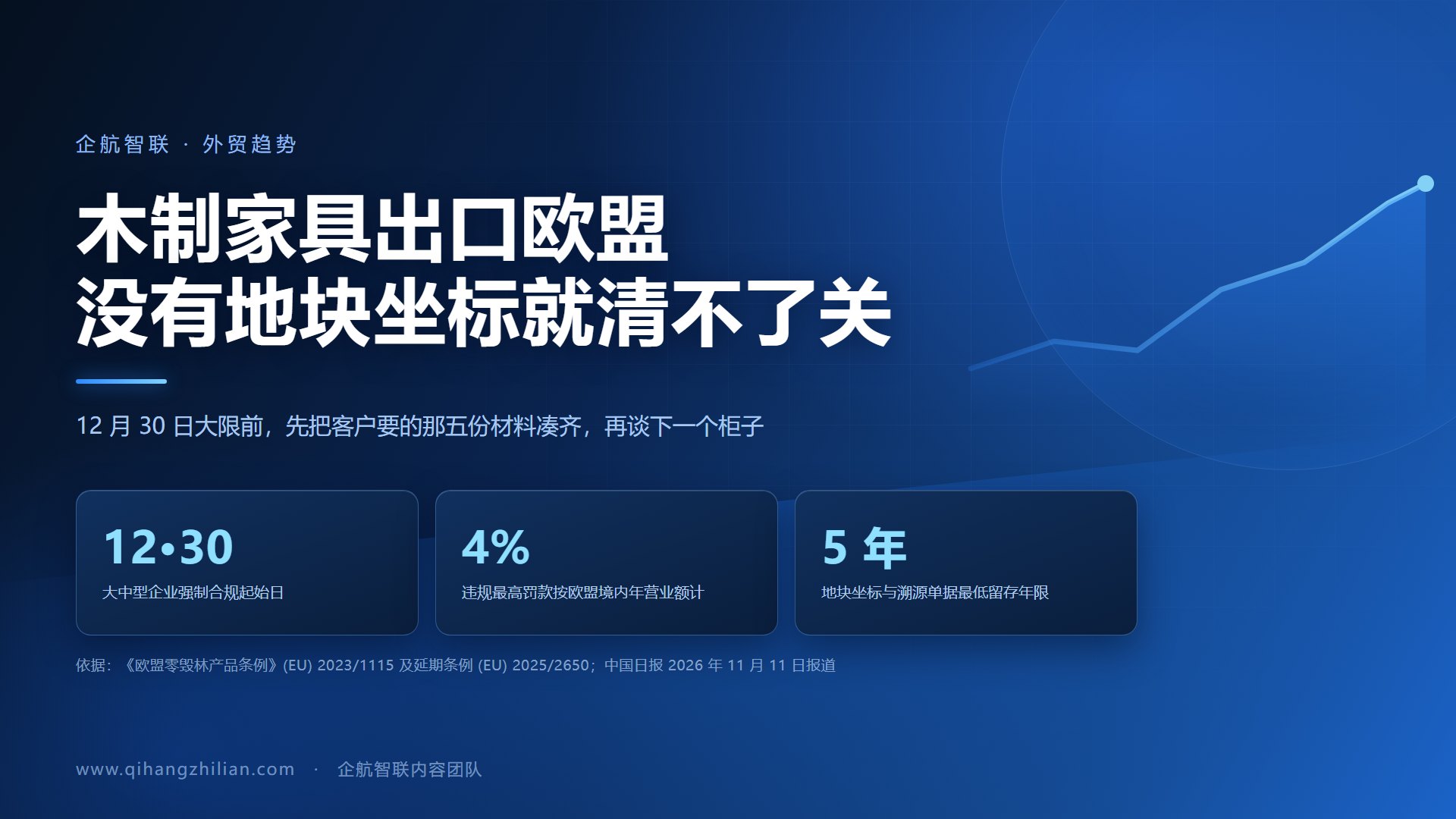
Key Conclusion: The mandatory compliance date for the EU Deforestation Regulation (EUDR) is December 30, 2026. For goods containing wood components, EU importers must submit a Due Diligence Statement (DDS) through the TRACES system to clear customs. According to a report by China Daily on November 11, China's exports of wood products to the EU reached approximately $6.21 billion in 2025. You don't need to file the declaration yourself, but without the six-decimal-place coordinates of the land parcel, your customer cannot complete their statement. There is only one criterion: can your customer complete the declaration independently using only the document package you provide? If yes, accept the order; if not, gather the necessary information before discussing pricing.
With only 42 days left until December 30, on November 4, the Shandong Provincial Department of Commerce relayed the EU's finalized customs code rules: starting December 30, logs, wood panels, and wooden furniture exported to the EU must submit a valid Due Diligence Statement to clear customs, with customs using TARIC code C716 for identification. After completing EU EORI number registration, overseas exporters can bind with member states to file declarations. The rules have progressed from "whether to do it" to "which code to use it with." Factories still quoting based on last year's experience will hit a wall this quarter.
I. This is not "another extension": Three dates have closed the window
The EUDR, or EU Regulation on Deforestation-free Products, numbered (EU) 2023/1115, came into effect in June 2023, replacing the EU Timber Regulation. After two extensions, (EU) 2025/2650 set the main application date for December 30, 2026, meaning the extension period has ended.
On December 30, 2026, large and medium-sized EU importers and traders will bear full compliance obligations. Small and medium-sized enterprises in the wood sector do not enjoy the six-month grace period and must comply on the same day, as clearly stated in the interpretation by the Shandong Provincial Department of Commerce on September 4. On June 30, 2027, small and micro operators in sectors other than wood will be subject to the requirements. Beyond that, December 30, 2027, corresponds to new categories added to Annex I, which have little relation to wood products but indicates the list is still evolving.
II. What's blocking your order isn't your factory, but that piece of land
When most factories first hear about the EUDR, they mistakenly think it's "just another certificate" and immediately ask where to get certified. There is no certification or issuing authority; it only recognizes three things: the raw material land parcel had no deforestation or forest degradation after December 31, 2020; production complies with the laws of the country of origin regarding land, environmental protection, and labor; and completion of due diligence to obtain a DDS number. Penalties can reach up to 4% of the company's annual turnover in the EU, and goods may be seized, delisted, or recalled (China Industrial Economy Information Network).
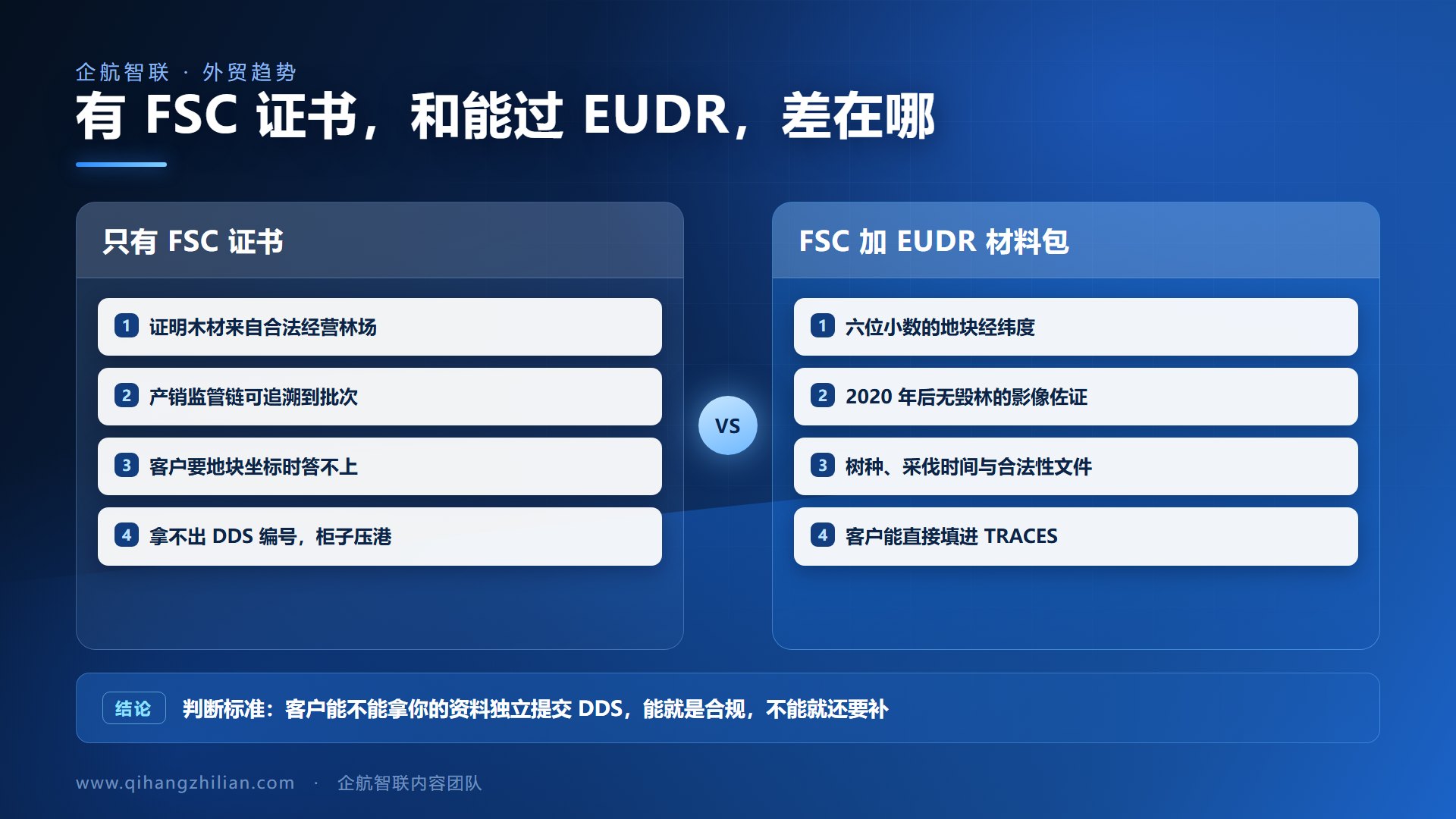
The difficulty lies entirely in the first point: tracing the finished product back to that specific forest—not just "wood from a compliant forest," but the coordinates of that forest. For areas less than 4 hectares, a single point coordinate can be used; for 4 hectares or more, a polygon boundary (GeoJSON) with at least six decimal places is required. Without it, importers cannot even complete the form in TRACES.
Looking at the requirements by entity type, who needs to submit what and when:
| Entity | Mandatory Compliance Start Date | DDS Submission Required | Land Coordinate Requirements |
|---|---|---|---|
| Large and medium-sized EU importers and traders | 2026-12-30 | Per batch submission | All land parcels, polygons for 4+ hectares |
| SMEs in wood sector (including European buyers of Chinese factories) | 2026-12-30 | Simplified statement allowed | All land parcels, none can be omitted |
| Chinese upstream factories (suppliers) | No defined obligation | Do not submit | Must provide when requested by customer |
The third column stating "Do not submit" is most easily misinterpreted as "not my concern," but the fourth column is non-negotiable—customers need your information to complete their forms. The "simplified statement" in the third column is not an exemption: while China is classified as a low-risk country, what is simplified is the procedure, not the coordinate requirements.
III. First confirm if your products are on the list: Seven categories and two exemptions
The EUDR covers seven categories of goods and downstream products: cattle, cocoa, coffee, oil palm, rubber, soy, and wood. Most Chinese factories fall under the wood category, which is much broader than "wooden furniture": logs, sawn timber, wood panels, wood flooring, wooden doors, picture frames, wooden pallets, cardboard boxes, paper labels—anything containing wood or paper components is theoretically within scope.
The regulation also provides two exemptions. The delegated act in July 2026 clarified the boundaries: packaging used solely for transport protection is exempt, but cardboard boxes and wooden pallets sold separately for pricing are not; used wooden products and recycled paper products are also explicitly exempt. Bamboo products follow a separate declaration code and do not use the wooden furniture process—manufacturers of bamboo products should first confirm which category they fall under.
Four things can be verified today; missing any one could jeopardize the entire shipment: check each model against the 8-digit CN codes provided by the customer, don't rely on Chinese product names; verify if accompanying pallets, cardboard boxes, and instructions are "solely for transport protection"—those sold separately must be included; separately list parts containing rubber or palm oil derivatives (cleaning agents, release agents); clarify whether the customer is an operator or downstream operator in TRACES—only the former requires all original documentation.
IV. FSC Does Not Equal EUDR: The Most Commonly Cited Statement When Customers Cancel Orders
"We have FSC, so we should be fine, right?" — This has been the most frequently asked question from factories in the past two months, and also the most expensive misconception. FSC addresses "where the wood comes from and whether the chain is broken" and is a Chain of Custody system; EUDR asks one more question "Has that land been deforested after December 31, 2020?" and requires proof using coordinates and remote sensing imagery. The benchmark assessment of FSC against ASI indicates that the core certification covers about 60-70% of the requirements, with the remaining 30% being coordinates, deforestation-free proof, and the DDS document system.
Even more dangerous are "EUDR compliance certificates" and "guaranteed approval services." The obligated party is the EU importer, who submits the declaration themselves. There is no third-party certificate that can be sold to Chinese factories. If someone claims they can obtain one, ask them: Can this certificate number be found in TRACES?
V. The Five Documents Factories Need to Prepare and an English Message That Can Be Sent Directly to Clients
Translating EUDR into actionable steps for factories results in a document package. With all five documents complete, clients won't bother you again:
- Request latitude and longitude coordinates for each species and batch from your primary wood or panel suppliers, with six decimal places. For plots larger than 4 hectares, GeoJSON polygons are required.
- Obtain harvesting time and land ownership proof (forest right certificate, harvesting permit), and confirm that plots harvested after 2020 have not been used in your materials.
- Build batch-by-batch ledgers, connecting raw material intake records, production work orders, and shipping documents into a traceable line that can be traced back to specific plots.
- Collect all legality documents: business license, environmental impact assessment, labor compliance, and align them with the laws of the country of origin.
- Organize by "client + batch" and save for at least 5 years. Keep scanned copies in the cloud, not just paper documents.
There are three ways to submit these documents, and whether the client can use them directly makes a big difference:
| Submission Method | Can Client Declare Directly | Subsequent Risk |
|---|---|---|
| Only providing an FSC certificate | No, lacks coordinates and deforestation-free proof | High, risk of containers being held at port, order changes, or returns |
| Purchasing "EUDR certificate" or guaranteed approval service | No, certificate number not found in TRACES | Extremely high, wastes money and delays shipping |
| Self-built ledgers, providing coordinates and legality documents | Yes, client can fill forms directly | Low, reusable, faster for repeat orders |
The second option should be firmly rejected. The difference between the first and third options isn't about money, but time: initial ledger organization takes two to three weeks, while subsequent batches only require data entry. Factories that only provide certificates will be questioned for every shipment until one misses the shipping deadline.
When clients follow up, don't reply "We will prepare as soon as possible." You can directly modify the content in brackets and send this:
[Client name], thanks for flagging the EUDR requirement. To keep [PO number] on schedule, here is what we can provide now:
1. Species and origin: [Species], sourced from [Province/Forest Farm], harvested in [Harvest Year/Month].
2. Geolocation: coordinates for [N] plots attached; plots above 4 hectares come as GeoJSON polygons in the same file.
3. Legality and traceability: land-use right certificate, felling permit and business licence are attached; lot [Batch Number] maps to the intake records in the same folder.
Still open: [Missing item], expected by [Date].
Please confirm whether you file the DDS as operator or downstream operator, so we send only what your TRACES entry requires.
Best regards,
VI. Frequently Asked Questions
1. I'm a small factory, so do I only need to comply from June 2027?
Not for wood, furniture, or paper products. Small and micro enterprises in the wood industry do not enjoy the extension until June 30, 2027. Like large and medium-sized enterprises, they are subject to all obligations from December 30, 2026. Even if you could get an extension, European clients will need to declare after year-end and will still ask for the documentation.
2. The client only wants the FSC certificate, do I still need to prepare coordinates?
Yes. The FSC certificate proves the chain of custody but cannot be entered into the TRACES location field. When clients get stuck, they will come back to you for coordinates, and by then there are usually only days left before the shipping deadline.
3. I don't have a forest farm, where do I get the coordinates?
Get them from your primary wood or panel suppliers; this is their obligation. When negotiating new contracts, include "providing plot coordinates and legality documents" in the procurement terms. This is more effective than chasing them after the fact.
VII. Conclusion
What EUDR truly changes is: previously, exports sold products; now, they sell products plus proof of the forest land behind them. When coordinates, species, harvesting time, and legality documents are complete, December 30 is just a matter of organizing documents. When they're incomplete, it becomes a gate that won't open just because you explain "we're a small factory."
There are 42 days left until year-end. Today you can do three things: check your EU export models against CN codes, send an email to your primary suppliers requesting coordinates, and scan existing documents into a folder. After completing these, this issue changes from "can we accept the order" to "when will we submit the documents."
Qihang Zhilian Content Team · Empowering Chinese Manufacturing to Set Sail Globally · For custom export acquisition solutions, please call 180-0327-6609