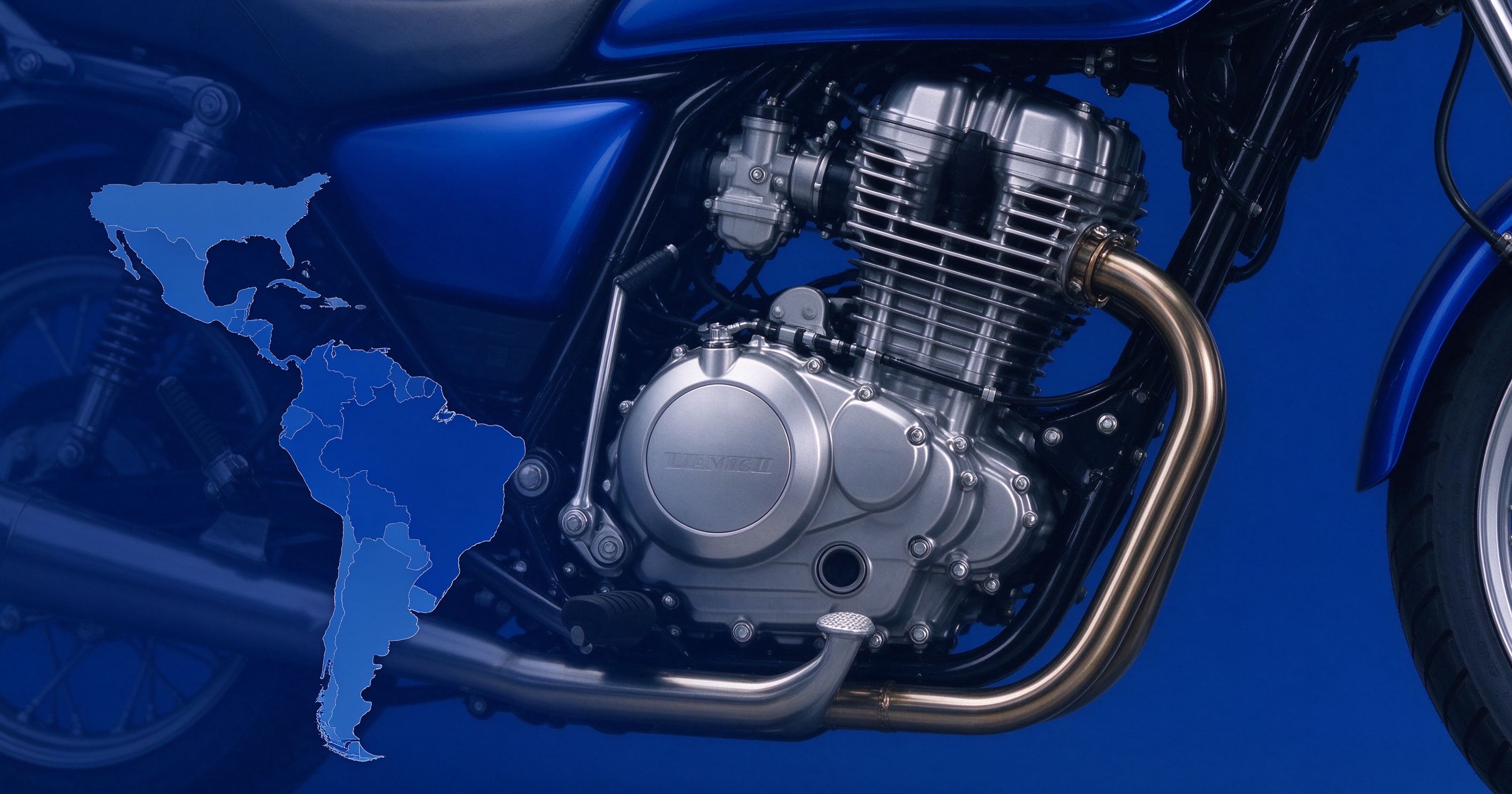
Core conclusions:A motorcycle parts factory in Chongqing used AI Spanish to open up the Latin American market. Latin American orders increased by 200% a year, accumulated 5 fixed customers in Mexico, and its profit margin was 18% higher than that in Southeast Asia.
1. Customer background
Chongqing is an important town in the domestic motorcycle industry. This factory is located locally and mainly sells motorcycle engine parts, including core components such as pistons, cylinders, clutches, and crankshaft connecting rods.
Its products are mainly supplied to domestic OEMs and after-sales markets, and are also exported to Southeast Asia. After several years of doing business, its business has been stable but growth is limited. The boss heard that Latin America is a market with a large number of motorcycles, and the demand for after-sales parts continues, but there are two concerns that have not been resolved: one is that he does not understand Spanish, and the other is that he does not know how to find local customers. These two concerns are precisely the common reasons why many factories miss out on the Latin American market.
2. Problem diagnosis: Why does the original path fail?
It is not that the factory has not tried Latin America, but it has not started running after trying. The reasons are concentrated on four points.
- The language threshold directly blocks people.Recruiting a Spanish-speaking foreign trade salesman has high salary requirements, long recruitment cycles, and difficult to retain. When people leave, the customer relationship is broken, which is the most troublesome part.
- Customer sources rely too much on the platform.It mainly relies on platform inquiries, among which Latin American customers account for a very low proportion. The quality of inquiries is uneven, and many of them are sporadic buyers asking retail prices.
- Spanish data is missing.There is no Spanish quotation, no Spanish product description, and no suitable model comparison table. Motorcycle accessories are a highly adaptable category. The first question customers usually ask is whether the item is suitable for my model. If they don't answer, trust will not be established.
- Not familiar with the local channel structure.Latin America's motorcycle aftermarket channels are clearly hierarchical. Importers, regional wholesale, and maintenance chains each have their own ways of playing. If you don't know who the real buyer is, it will be easy to waste time on invalid customers.
3. What have we done?
The core idea is to replace overseas salesmen with language and data capabilities: let AI speak Spanish, let AI speak Spanish, letcustoms dataDirections.
- Latin American customs data screening.Focus on screening motorcycle parts importers in Mexico, Brazil, and Argentina, looking at actual procurement records rather than guessing who might need it.
- AI Spanish Development Letter.Development letters, quotations, and product descriptions are all Spanish. They are generated by AI and then manually proofread professional terms, and the rhythm is automatically implemented.
- WhatsApp automatically replies in Spanish.Latin American customers rely heavily on App,7 x 24 hoursAutomatic reception, and common adaptation questions, price ranges, and MOQ can be answered instantly.
- Precise invitation before the Mexican Motorcycle Show.Reach target customers in batches before the exhibition, clarify the main models and suitable models, and lock in before the exhibitionof 20Intended customers.
- Accessories adaptation table is Western-language.By making a comparison table between the engine model and the part number, customers can find the corresponding part number after reporting the model. This step greatly reduces communication costs.
4. Execution rhythm
Month 1: Cleaning and adapting customs data
Clean and layered the data of importers in the three countries, and at the same time organize the factory's parts adaptation relationship into a structured table-which parts are suitable for which engine models, which years, and which displacements. This form is the basis of the whole extension system.
Month 2: Spanish asset construction and reach online
Complete the Spanish quotation, product manual, and adaptation checklist, and WhatsApp will automatically reply to the verbal entry. The development letter has prepared several angles to test which one is better, such as complete adaptation, production capacity and delivery period, and price structure.
Month 3: Mass access and exhibition invitations
Entering the large-scale reach stage, key customers will follow up one by one, and the rest will be sent in batches and automatically transferred. In the same period, pre-exhibition invitations were made around the Mexican Motorcycle Show, and prospective customers were invited to the site to confirm samples and prices. The first round of follow-up will be completed within 48 hours after the exhibition.
Months 4 to 12: Transaction implementation and share penetration
After the sample list and small batch orders were completed, the focus turned to the stocking rhythm and replenishment forecast. The demand for after-sales motorcycle parts is continuous. As long as the delivery date and quality are stable, customers will continue to place orders. At this stage, fixed customers have gradually accumulated in the Mexican market, and the share of after-sales channels has gradually increased.
V. Outcome data
- Latin American order growth:200%
- Mexico Fixed Customers:of 5, accounting for approximately the local aftermarket15%the share of
- Spanish team: In this case, it is not formed separately. Development letters and daily communication are undertaken by the AI translation system
- Profit margin: 60% higher than the original Southeast Asian market18%
- Exhibition transformation: Among the 20 intended customers targeted before the exhibition, many entered the proofing and quotation stage after the exhibition
6. Which factories can this method be replicated to?
This method is suitable for factories with three types of characteristics established at the same time: the products have clear adaptation relationships, the target market has obvious language thresholds, and the local after-sales demand is continuous. Motorcycle parts, automobile parts, agricultural machinery parts, engineering machinery parts, and home appliance parts all match this portrait. Conversely, if it is a universal component that customers can buy anywhere, and the price is the price, then the premium space brought by language localization will be limited. The criterion for judgment is: before customers buy your things, they must first confirm whether they can be installed. Yes, it is worth deepening the adaptation system.
7. Common questions
Q: Is it really possible not to hire a Spanish-speaking salesperson?
A: There is no special Spanish team set up in this case. The AI Spanish system handles the receipt of inquiries, regular answering questions, and quotation sending. Manual only handles the links that require judgment, such as price concessions, delivery coordination, and quality issues. If the order volume continues to increase, adding a business person who understands Spanish will make it more efficient, but the initial stage is not a necessary condition.
Q: How to control the payment risks of Latin American customers?
A: In the early stage of this case, the main focus is on sample lists and small batch orders. Transaction records are first established and then the volume is gradually increased. At the same time, basic verification is made through customs declaration data and customer background. The specific settlement method should be discussed separately based on the situation of each customer. For orders with large amounts, it is recommended to do enough homework on the contract terms and rely on professional institutions for evaluation if necessary.
Q: How detailed should the adaptation meter be?
A: At least detailed enough that customers can check for themselves. What is done in this case is to compare the part number according to three dimensions: engine model, displacement, and year, and the customer can locate the model after reporting it. The more detailed this step is done, the more time saved in early communication and the fewer subsequent after-sales disputes.
