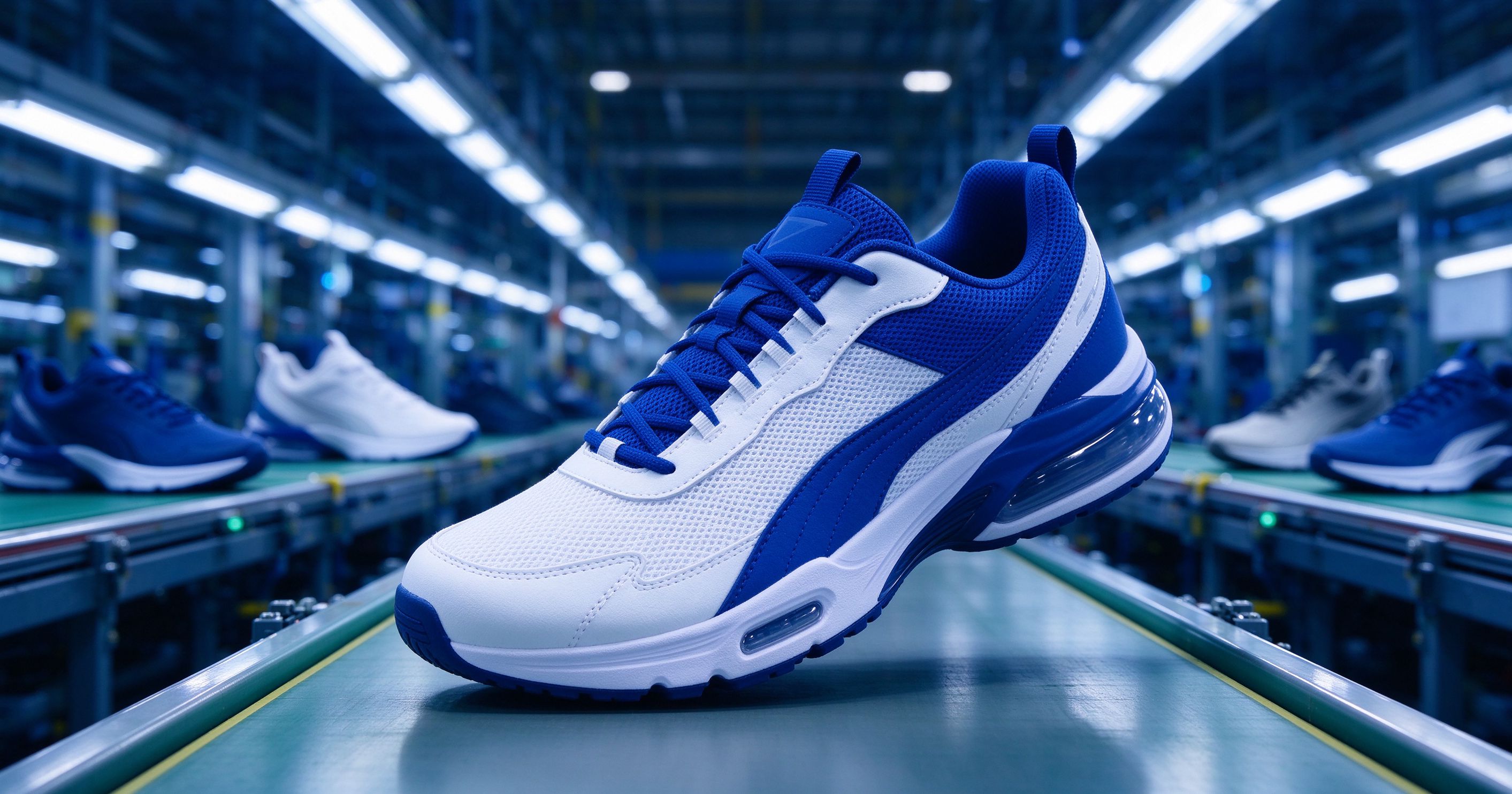
Core conclusions:Through GEO optimization and structural transformation of independent stations, a shoe factory in Quanzhou, Fujian Province allowed overseas brand purchasers to actively find factories in AI search and directly connect with 12 overseas brand customers in 8 months.
1. Customer background
This shoe factory is located in Quanzhou, Fujian Province. It belongs to the local shoe industry cluster. It mainly specializes in casual shoes and sports shoes. It has relatively complete development and proofing capabilities and a stable production line.
Its model over the past decade or so has been very simple: to work as an OEM for a foreign trade company. Orders are given by others, prices are set by others, a pair of shoes earn a few dollars processing fees, large but thin. The boss knows exactly what the problem lies-if the customer is not in his hands, the factory has no bargaining power. Today, this trader placed the order, and it may be someone else tomorrow. He wants to directly connect with overseas brand customers, but he has always been stuck on one thing: the customers do not know he exists.
2. Problem diagnosis: Why does the original path fail?
He stopped all the self-built websites and promotions he had tried several times before. The reason seemed to be that it was ineffective, but in fact, the method was used in the wrong place.
- Customer resources are in the hands of traders.The factory is only responsible for production, does not have information on the purchaser, and does not export brands to the outside world. All business contacts are cut off by intermediate links.
- Independent Station has it, but it is not friendly to AI.The site can be opened, but the product information is scattered in the pictures. Production capacity, minimum order quantity, and proofing cycle, which are the most concerned about by the buyer, are not structured into content that can be understood by machines.
- The keywords were chosen in the wrong direction.The words we did before were too general, and most of the people searched were end consumers, not brands who came with purchasing intentions. If the word is wrong, no matter how large the traffic is, it will not be converted into an order.
- The content is not persuasive enough.When the purchaser judges whether a factory can cooperate, it looks at the production capacity scale, development cases, minimum order quantity, and delivery instructions. The information was not clearly presented, and the other party still dared not continue to talk after reading it.
3. What have we done?
The direction is clear: instead of grabbing retail traffic, we will let brands with purchasing intentions find the factory in AI and search.
- Deploy GEO optimizations.Reconstruct the content around the true questioning methods of overseas buyers, so that when customers search for questions such as custom sneaker manufacturer China in ChatGPT and Google AI Overviews, the factory can be identified and recommended.
- The independent station was completely redone.Upgrade from a product catalog to a factory capabilities display page: production line equipment, monthly production capacity, development team, proofing process, and factory inspection data are all placed in a conspicuous position, allowing the purchaser to determine whether the factory is qualified or not within 3 minutes.
- The case page is displayed in multiple languages.Clarify the actual cooperation methods of OEM and ODM, and explain the coordination process with real production nodes and delivery rhythm, instead of just putting a few photos of finished products.
- Structured data Schema tags.Add structured tags to factory information, product information, and frequently asked questions and answers, allowing search engines and AI to accurately capture and understand, and reduce distortion in the information transmission process.
4. Execution rhythm
Month 1: Information asset inventory and structural transformation
First, make clear the factory's own information: what shoe models can be made, what is the monthly production capacity, the minimum order quantity, how many days it takes for proofing, and what processes it supports. If the factory itself cannot explain these numbers, it is even less likely for customers to know them. After the inventory is completed, reorganize and go online in the format of structured data.
Month 2: GEO content matrix laying
Build content around the buyer's search intentions: how to choose a sports shoe OEM, the difference between ODM and OEM, how long the proofing cycle is generally, and what to prepare for a factory inspection. Content does not pursue quantity, but seeks to answer real questions. At the same time, align the information between each page to avoid contradictory statements.
Month 3: AI Citation and Enquiries Quality Monitoring
Start monitoring the frequency of factories being mentioned and cited in AI searches, and at the same time look at the structural changes of inquiries: are consumers asking about retail sales, or are brands asking about minimum order quantities and delivery dates. Continue to adjust the content direction based on data feedback and slowly filter out flood traffic.
Months 4 to 8: Brand customer conversion
After the quality of inquiries stabilized, the focus shifted to docking and transformation. Brands usually ask about production capacity first, then ask for samples, and then inspect the factory. The entire cycle is much longer than retail sales, so the information for each link must be prepared in advance. In this case, a total of 12 overseas brand customers have been directly connected in 8 months.
V. Outcome data
- Directly connect with overseas brand customers:the 12Three of them are European niche sports brands.
- Single and double profits: increase40%
- AI Source Enquiries: Percentage of total inquiries35%, and mainly direct purchasers
- Monthly visit to Independence Station:More than 3000 times, brand purchasers account for a relatively high proportion in the visit structure
6. Which factories can this method be replicated to?
The premise for the establishment of this method is that the factory has real production capacity and development capabilities, but the customers are intercepted by middlemen; the products can be described in a standardized manner, and the purchaser has clear factory selection needs. It is more suitable for industries such as shoes and clothing, bags, hardware, consumer electronics parts, packaging and printing that have strong OEM attributes and fierce competition from the same industry. On the other hand, if the factory only takes orders for production and cannot even explain its own production capacity and delivery date, GEO optimization will not help-the premise that AI is willing to quote is that there is something worth quoting. So the first step is always to digitize your abilities, and the second step is to let AI find you.
7. Common questions
Q: What is the difference between GEO optimization and traditional SEO?
A: Traditional SEO optimizes the ranking in search results, and users also need to click on the website;GEO optimizes whether AI will quote you when answering questions, and users will get the answer directly. What we do in this case is two-pronged preparation: not only to allow the page to be searched, but also to make the page content structure clear enough to be accurately crawled and quoted by AI.
Q: Is the quality of customers recommended by AI really higher?
A: In this case, AI source inquiries account for about 35% of the total. They are characterized by strong initiative-the customer is already doing factory selection and comparison, and the questions they ask focus on production capacity, minimum order quantity, and delivery time, rather than asking in general terms price. The communication costs of such customers are relatively lower, but the conversion cycle is also longer and requires the patience of the factory.
Q: If all factory information is disclosed, will it be copied by peers?
A: What can be disclosed is capability information such as production capacity, equipment, and processes. The real competitiveness lies in the implementation details-the same production line has great differences in delivery stability, quality control level, and cooperation degree. In this case, the factory chose to disclose capability data, in exchange for the trust of the buyer and a shorter communication link. This exchange is cost-effective.
