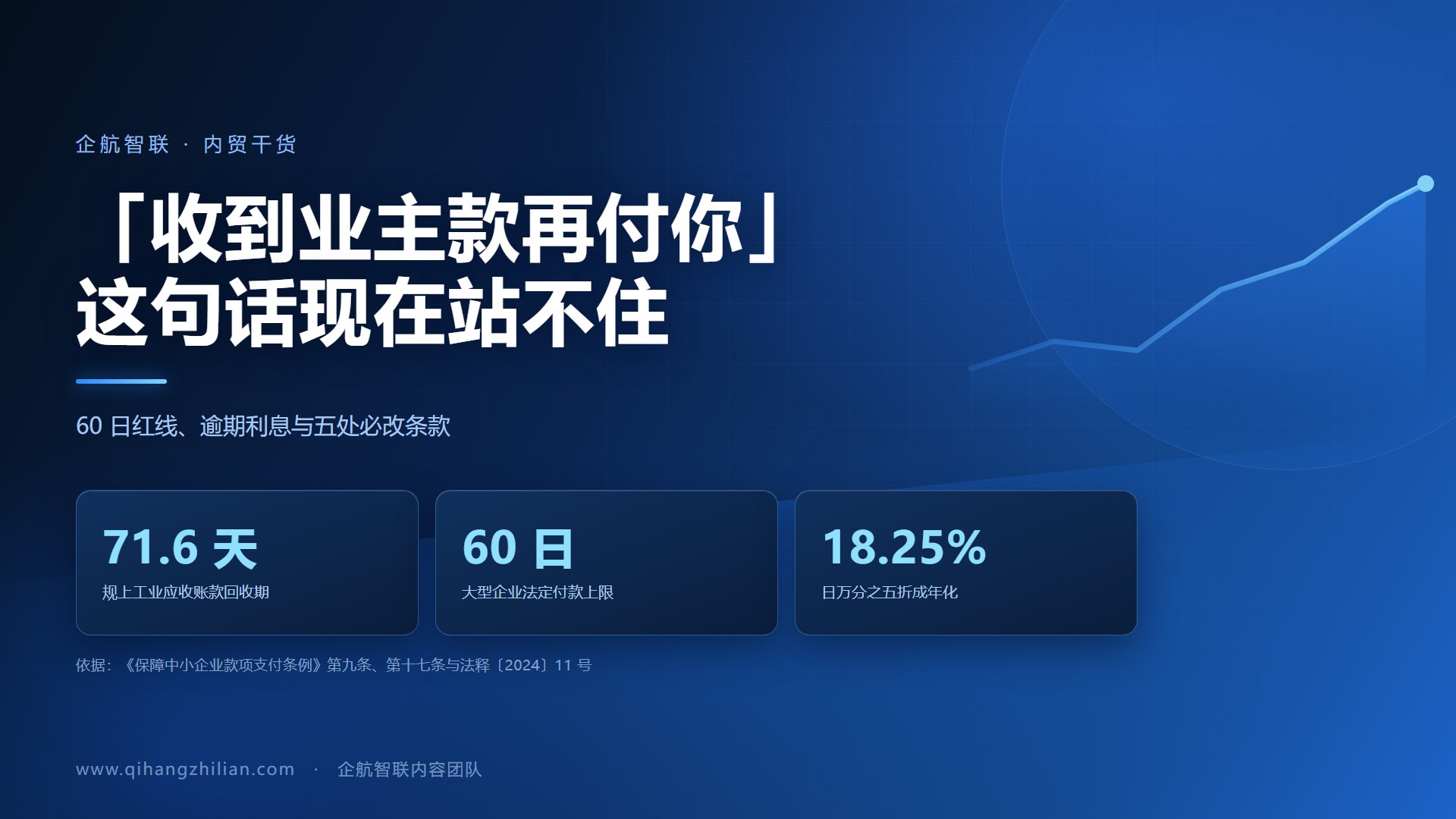
Core Conclusion: Clauses like "I'll pay you after receiving payment from the client" are no longer enforceable in contracts between large enterprises and SMEs. The Supreme People's Court Judicial Interpretation [2024] No. 11 clearly states that such agreements are invalid, and courts will determine payment periods based on industry standards and transaction practices. The criteria are threefold: the contract was signed after September 1, 2020; the other party is a large enterprise; and you have formally informed them in writing that you are an SME. Only when all three conditions are met can this clause no longer be used as a reason for payment delays. If any one condition is missing, don't push your luck in negotiations.
National Bureau of Statistics data shows that as of September 2026, the average collection period for accounts receivable from designated industrial enterprises was 71.6 days, an increase of 1.3 days year-on-year, exceeding the 60-day limit set for large enterprises by 11.6 days. On November 20, the 1-year LPR was reported at 3.0%, unchanged for 6 consecutive months (Jingwei). For each day of delay, the minimum interest rate you can claim is capped at this 3.0% unless your contract specifies a higher rate.
I. Why This Clause Is No Longer Enforceable: Two Documents, One Logic
The chain of reasoning is as follows: Article 9 of the Regulations on Guaranteeing Payment of SMEs' Funds stipulates that large enterprises must pay SMEs within 60 days of delivery. Any contractual provisions must be reasonably determined according to industry standards and may not stipulate "payment upon receipt of third-party payment." Such provisions conflict with Article 153, Paragraph 1 of the Civil Code - civil legal acts that violate mandatory provisions are invalid - and are therefore deemed invalid.
A detail that's easy to overlook: the judicial interpretation cites Articles 6 and 8 of the 2020 version of the regulations. The new version, effective June 1, 2025, has renumbered articles, with the corresponding content now being Articles 7 and 9. Citing the new article numbers while noting the correspondence to the old ones prevents the other party's compliance department from finding fault.
The invalidity of the clause does not mean "immediate payment." According to Article 2 of the interpretation: first, negotiate supplementary terms; if agreement cannot be reached, determine the payment period based on industry standards and transaction practices. For interest, follow contractual terms if specified; if illegal or unspecified, calculate based on the 1-year LPR - which explains the significance of 3.0%, serving as both the statutory minimum and the fallback rate.
II. Converting Payment Terms into Money: The Difference Between 60 and 180 Days
When the other party says "wait a little longer," it translates into specific amounts on financial statements. Based on 1 million yuan with two different interest calculation methods:
| Overdue Payment Term | Calculated at 1-year LPR of 3.0% | Calculated at daily 0.05% (18.25% annualized) | Difference |
|---|---|---|---|
| 90 days | 7,397 yuan | 45,000 yuan | 37,603 yuan |
| 120 days | 9,863 yuan | 60,000 yuan | 50,137 yuan |
| 180 days | 14,795 yuan | 90,000 yuan | 75,205 yuan |
Look at the last column. If the contract only states "calculated at LPR," the compensation for delaying 180 days is 14,800 yuan, less than one fifth of the daily 0.05% calculation (75,200 yuan). Negotiating a 1% price increase only amounts to 10,000 yuan, but with the correct interest clause, the difference for 180 days is 60,000 yuan.
Calculation method: Invoice amount × annual interest rate × overdue days ÷ 365; daily 0.05% is calculated as 0.05% × days. Both columns exclude litigation costs and capital costs, with actual losses being greater.
III. Three Negotiation Approaches: Which to Discuss First
When the other party wants to add this clause, your response will lead to vastly different outcomes. The opening statements, acceptance rates, and remaining risks for three response approaches:
| Response Method | How to Open (Original Statement) | Party Acceptance | Our Remaining Risk |
|---|---|---|---|
| Directly Delete Clause | "Revised according to Article 9, payment within 60 days after delivery and acceptance" | Medium: Compliance department approves, procurement fears changing template | Low: Clause is clear, payment term remains 60 days |
| Change to Bank Acceptance | "We can accept drafts, but only bank acceptances, with discount interest borne by your company" | High: Other party willing to provide acceptance | Medium: Discount costs and acceptance risks |
| Retain Clause for Price Increase | "Payment according to owner's progress is acceptable, with price increase of 3%" | Medium: Requires approval, procurement unwilling to bear price increase | High: If owner doesn't pay, you still can't claim |
| Sign First, Claim Later | Sign first, then after delivery, file lawsuit to claim clause invalid based on approval | Highest: Fastest to sign | High: Cash flow advanced first, first trial takes at least 6 months |
Look at the third and fourth columns. The "Medium" in the first row doesn't mean the clause is untenable—it means procurement needs approval to change the template. Sending the two document numbers (Article 9 and Judicial Interpretation [2024] No. 11) to the compliance department is more effective than arguing. The third row seems like the smart approach but is actually the most expensive: a 3% price increase only covers capital costs, and when the owner doesn't pay, you don't even have standing to claim. The fourth row is only suitable for existing accounts receivable.
IV. Five Clauses That Must Be Modified Before Signing
When you receive the other party's template, modify it according to the following five points; for clauses that cannot be changed, at least leave a written objection:
- Payment Period: Change "within X days after acceptance" to "within 60 days from the date of delivery and acceptance," and specify that the acceptance period shall not exceed 15 days—Article 10: if the other party delays acceptance, the period shall be calculated from the expiration of the agreed acceptance deadline.
- Third-party Conditions: Delete "payment will be made after receiving payment from the client." If it cannot be deleted, annotate next to the clause "conflicts with Article 9 of the regulations, our company does not approve," and email it back to the contact person for records.
- Payment Method: Only accept bank acceptance bills for commercial drafts, with a note that discount interest shall be borne by the other party; for accounts receivable electronic vouchers, clearly state the maturity date and payment entity—Article 11 prohibits using such tools to extend the payment period in disguise.
- Entity Notification: In writing at the time of signing, inform the other party that you are a small and medium-sized enterprise (SME), and attach the "Declaration Letter for SMEs" as a contract appendix—Article 3 requires proactive notification, and without this clause, the validity of claiming invalid terms may be questioned regarding your entity status.
- Overdue Interest: Write "overdue interest shall be calculated at 0.05% per day," and delete expressions like "the contract price includes compensation for overdue payment," as Article 2 allows the other party to use this to argue for liability reduction.
V. Payment Has Been Delayed for 90 Days, Follow These Four Steps
1. First, Create an Overdue Ledger
For each invoice from the same client, list four columns: delivery date, acceptance date, due date, actual payment date, with interest listed separately. For multiple invoices, consolidate your claims; if exceeding 500,000 yuan, don't wait for verbal responses—promises made in meetings are binding in court.
2. Send a Demand Letter Specifying Legal Provisions
You can send the following after replacing the bracketed content:
"Our company and your company signed the '[Contract Name]' (Contract No.: [No.]) on March 12, 2026. Our company completed delivery and was accepted by your company on April 8, 2026. The payment of RMB [amount] should have been made by June 7, 2026. As of November 26, 2026, this payment is [days] days overdue, with overdue interest of [interest] yuan calculated at 0.05% per day. According to Articles 9 and 17 of the 'Regulations on Guaranteeing Payment of SMEs,' please pay the above amount and interest within 10 days after receiving this letter. If payment is not made, our company will complain to the SME department of [Province] and reserve the right to claim the full amount and interest through litigation. Our company is an SME and has informed your company in writing at the time of signing."
This is more useful than "please arrange payment soon"—it provides everything needed for compliance and finance departments to process: contract number, delivery and acceptance dates, due date, days overdue, legal provisions, amount, and deadline. Missing any of these will likely send this letter to the general accounts queue.
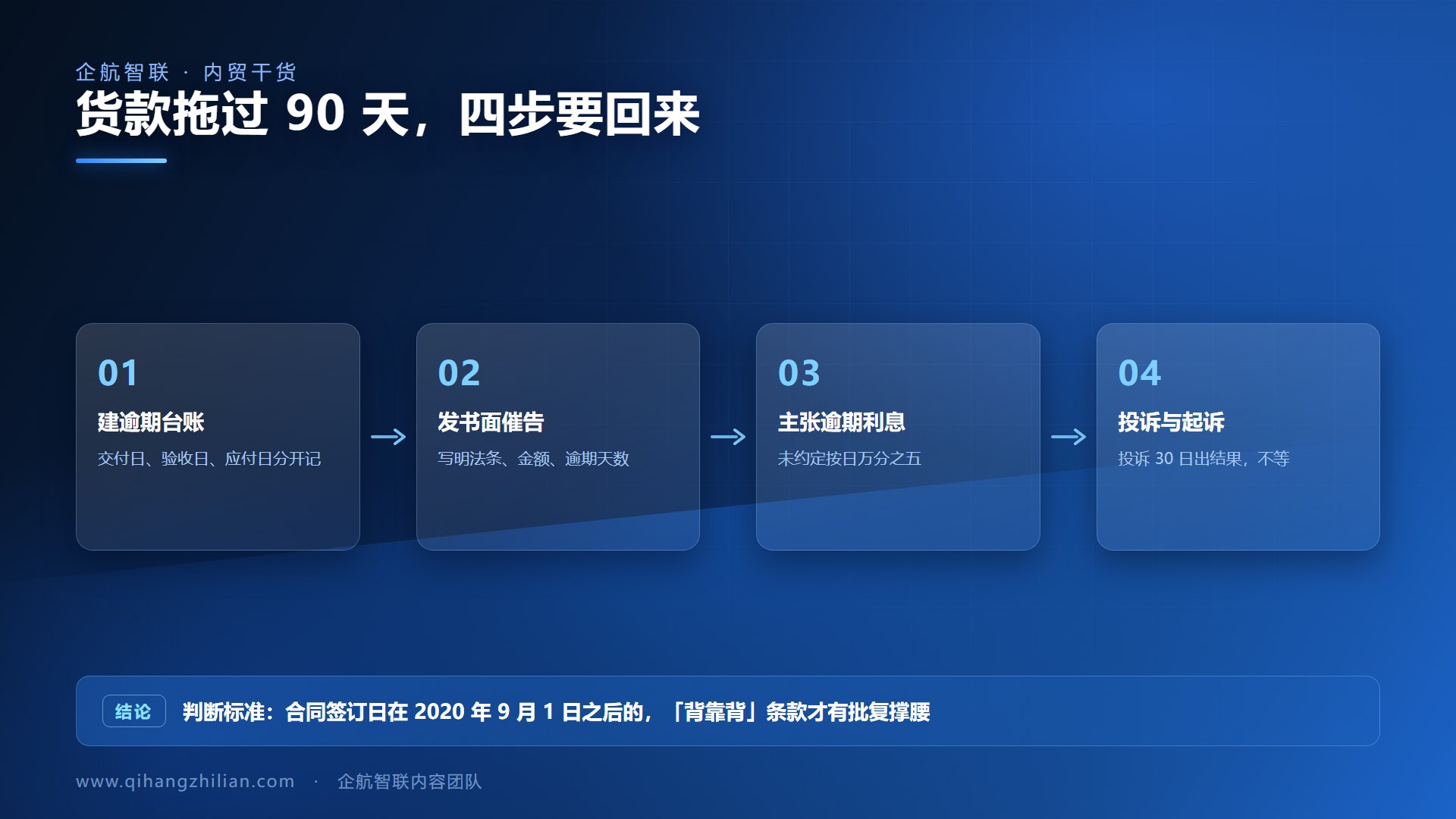
3. File Complaints and Lawsuits Concurrently, Don't Wait in Line
Complaints go through provincial SME departments: the receiving department transfers within 10 working days, and the handling department produces results within 30 days, with a maximum of 90 days. The value is not just in the results—overdue information enters the credit record and is made public, and the other party often approaches you for negotiation during the transfer phase. Prepare lawsuit materials simultaneously.
The statute of limitations for litigation is 3 years, but what's easier to lose than the statute of limitations is the chain of evidence. If one of acceptance certificates, account statements, or signed records is missing, "delivered and accepted" becomes questionable; if the premise collapses, it's unclear when the 60-day period begins.
VI. Common Questions
1. The other party is a state-owned enterprise, and the contract states "settlement based on audit results." Can this be changed?
It can be proposed. Article 12: government agencies, public institutions, and large state-owned enterprises shall not compulsorily use audit results from audit authorities as the basis for settlement. Propose in writing to settle at the contract price, which is more useful than saying "this is unreasonable" in a meeting.
2. The contract doesn't specify overdue interest. Can we still claim it?
Yes. Article 17: if not specified, overdue interest shall be paid at 0.05% per day. For 1 million yuan overdue for 90 days, that's 45,000 yuan. If specified, the interest rate shall not be lower than the 1-year LPR at the time of contract signing, which is currently 3.0%.
3. Will complaining completely alienate the client?
For accounts that reach the complaint stage, the client relationship is usually already exhausted. Most are resolved during the transfer phase: the impact of overdue disclosure on the other party's financing and bidding is far greater than paying this amount. When sending the letter, make a phone call saying it's "required by internal procedures" to give them a way out.
4. How to prove you are an SME?
Prepare a declaration letter based on the "Provisions for Classification Standards of SMEs" comparing your industry's operating revenue and number of employees, and submit it in writing to the other party at the time of signing. The scale type is determined at the time of contract signing, don't wait until a dispute occurs to supplement it.
VII. Conclusion
With properly negotiated terms, established records, and formal payment reminders, "I'll pay you after receiving payment from the client" will no longer be a statement you can only nod to. The real risk isn't the other party's strong position, but the lack of a document specifying delivery and acceptance dates: even the most favorable terms are meaningless without calculating the number of days overdue.
Qihang Zhilian Content Team · Empowering Chinese Manufacturing to Set Sail Globally · Customized domestic and international customer acquisition solutions. Call 180-0327-6609