Core Conclusion: Government procurement is not about "connections getting you in," but about "qualification getting you to bid." According to the Q&A on the "Measures for the Administration of Government Procurement to Promote the Development of Small and Medium-sized Enterprises", for goods and service projects with procurement value above the threshold but below 2 million yuan, if suitable for small and medium-sized enterprises, the procuring entity should specifically target SMEs. There's only one criterion: search the China Government Procurement Network for winning bid announcements in your industry over the past three months. If there are fewer than 3 bids under 2 million yuan in a year, this channel isn't worth dedicating resources to; if there are bids every month, spend the first two weeks preparing your supplier registration and five required documents.
This is worth discussing now because the preferences are written in policy documents, not based on personal relationships. The Ministry of Finance and Ministry of Industry and Information Technology provided a baseline in a Q&A: the amount of government procurement awarded to SMEs already accounts for over 70% of the total procurement scale (China Government Network). Seventy percent of the funds already flow to enterprises of similar scale to yours. The bottleneck for factories is often not qualifications, but not knowing where to register, which documents to prepare, or how to fill out the bid proposal.
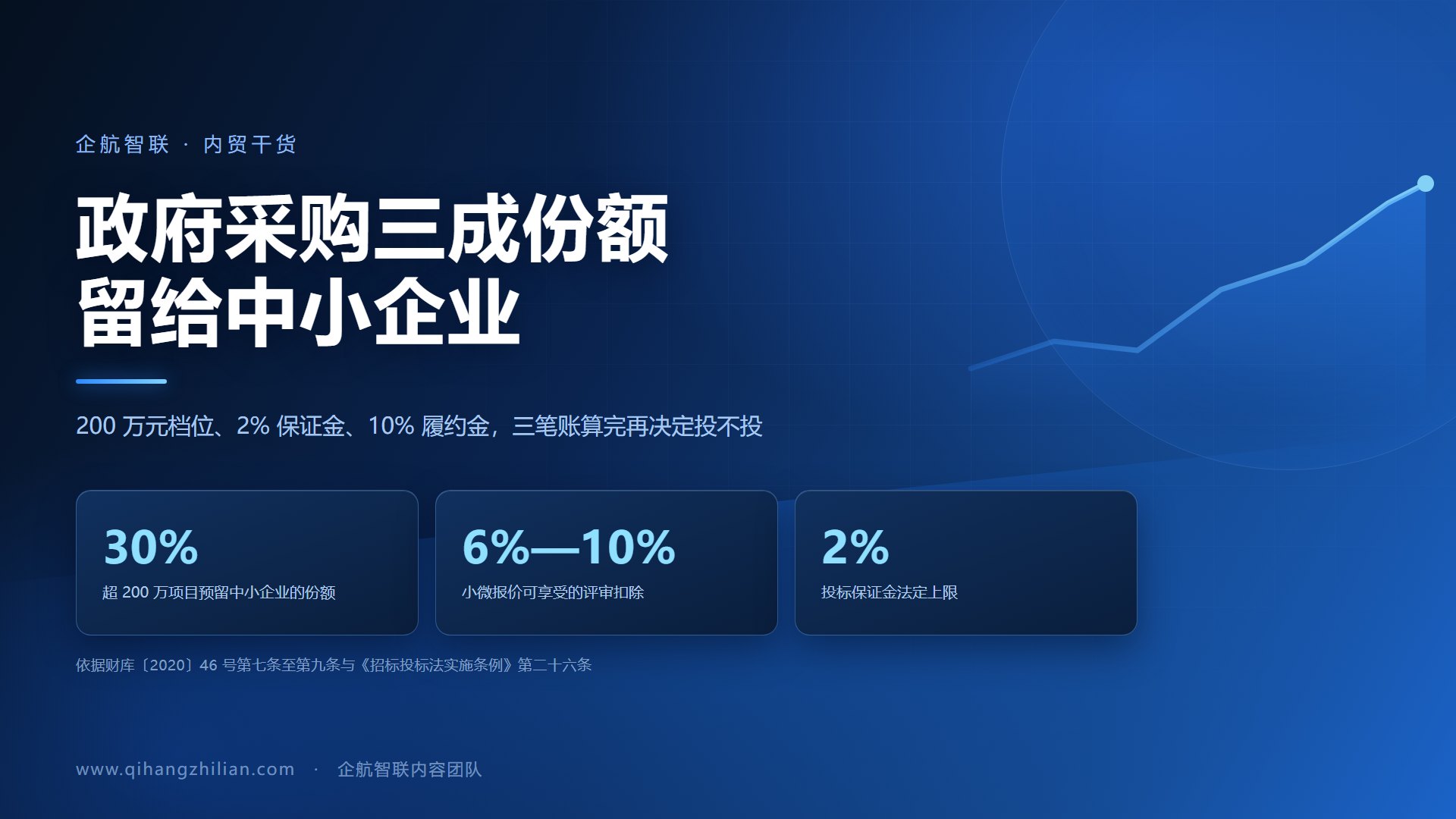
I. The 2 Million Yuan Threshold: Competing with Similar-Sized Factories or Large Corporations
Government procurement is categorized by budget amount, with different brackets having completely different competitors. Only three numbers affect the decision: the threshold below which procurement must specifically target SMEs, the percentage reserved above that threshold, and the price deduction for micro-enterprises in non-reserved projects.
By bracket, you can directly find where your product line fits:
| Project Bracket | Specifically for SMEs | Micro-enterprise Price Deduction | Factory Strategy |
|---|---|---|---|
| Goods, Services under 2 million yuan | Should specifically target SMEs | No additional price deduction | Main battlefield, bid directly according to announcements |
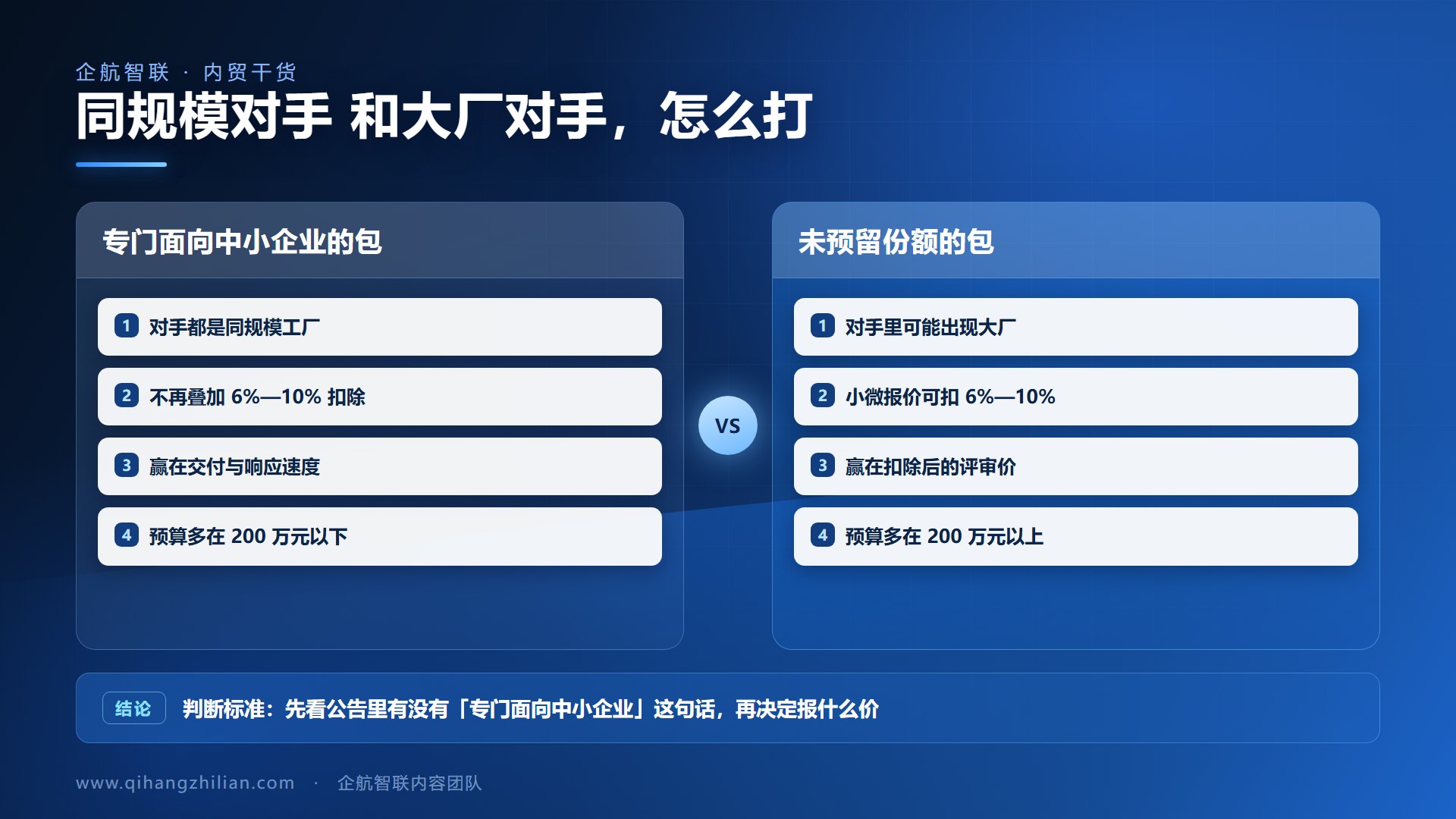
| Goods, Services over 2 million yuan | Reserve 30%+ share, with 60%+ for micro-enterprises | 6%-10% deduction for non-reserved portions | Target the reserved packages, or participate as a consortium or subcontractor |
| Construction under 4 million yuan | Should specifically target SMEs | No additional price deduction | Only enter with construction qualifications, avoid pure supply |
| Projects without reserved shares | All suppliers compete | Micro-enterprise price deduction of 6%-10% | Rely on deduction to maintain evaluation price |
First, look at column 2: packages marked "specifically for SMEs" have competitors of similar scale, where delivery speed and responsiveness matter. Then look at column 3: in projects not marked this way, the 6%-10% deduction is the only pricing weapon available. Many factories fail to win any of their first five or six bids, mostly because they're practicing with large packages over 2 million yuan.
II. Calculate Three Costs Before Choosing Your Approach: Direct Bidding, Subcontracting, or Entering E-Marketplaces
According to the "Implementation Regulations of the Tendering and Bidding Law of the People's Republic of China", the bid security shall not exceed 2% of the estimated price, and the performance security shall not exceed 10% of the contract amount for the winning bid; for unsuccessful bidders, the security shall be refunded within 5 days after the contract is signed, with interest calculated at the same period deposit rate.
Calculating three costs for a tender with 1.8 million yuan worth of goods: bid security ceiling is 36,000 yuan (×2%), performance security ceiling after winning is 180,000 yuan (×10%); estimated from signing to acceptance is 6 months, with 216,000 yuan tied up, which at an annual rate of 6% translates to approximately 6,480 yuan (216,000 × 6% × 0.5). There's also an invisible cost: for domestic trade, a 13% VAT special invoice must be issued, and when quoting, this 13% is often treated as profit, resulting in a loss once the bid is won. The 6% is hypothetical; recalculate using your own loan interest rate.
Once the costs are clear, the three approaches differ significantly in their initial contact methods, payment cycles, and bottlenecks:
| Approach | Initial Contact Method | From Contact to Payment | Main Bottlenecks |
|---|---|---|---|
| Directly bidding on packages under 2 million yuan | Register as a supplier on government procurement websites, download tender documents and compile bids according to format | 1-3 months | Ability to issue 13% special invoices and self-fund production capital |
| Following general contractors as a subcontractor | Find integrators who have won bids in your industry in the past six months, send sample machines plus quotation forms, and ask "Do you need配套 for this package?" | 2-4 months | Subcontract contracts are dominated by general contractors, payment terms follow accordingly |
| Entering provincial e-marketplaces or framework agreements | Apply for store entry, list standard models, and transact at pre-qualified prices | 2 weeks-2 months | Unit prices are capped, relying on volume sales |
The third column deserves the most attention. Direct bidding offers the fastest payment but at the cost of bearing the security deposits and capital advance yourself; subcontracting transfers financial pressure to the general contractor but results in longer payment terms and weaker bargaining power; e-marketplaces are suitable for standard products and fast-replenishment items, with customized products essentially playing a secondary role. It's unrealistic to pursue all three paths simultaneously; choose one based on "what you sell" and establish it first.
III. Five Essentials for Your First Bid: Missing One Could Lead to Disqualification
Among the reasons for bid disqualification, "incomplete materials" and "non-responsive" are most common, not price. Prepare these five items in order, don't expect to supplement them before the bid opening:
- Register as a supplier on both China Government Procurement Network and the provincial government procurement website where the project is located, upload complete business license, bank account information, and last year's financial statements, and only proceed with bidding after approval.
- Confirm your classification as medium, small, or micro according to the sizing standards, write the number of employees and last year's operating revenue on the same document, and stamp with official seal for filing.
- Download the SME declaration template from the attachments in the tendering method, only modify the company name, amount, and industry, and do not change any wording yourself.
- Prepare a performance table for similar projects in the past three years: scan the first page, amount page, and acceptance form of each contract, combine them into one PDF, and directly use individual pages when bidding.
- Document your ability to issue 13% VAT special invoices: general taxpayer qualification certificate plus recent three months' invoicing records.
The second item is most prone to errors. Size classification follows the "Provisions on SME Classification Standards" by industry: under industrial classification, enterprises with fewer than 1,000 employees or operating revenue below 400 million yuan are SMEs, among which those with 20 or more employees and revenue of 3 million yuan or above are classified as small. Overstating constitutes providing false materials to win the bid, leading to inclusion in the list of improper conduct and being prohibited from participating in government procurement for one to three years; understating equals voluntarily giving up deductions, resulting in losses on both sides.
IV. A Ready-to-Use Email Template: How to Make Initial Contact with Procurement
From announcement to bid deadline is typically only about twenty days, with most time spent preparing bid documents. To confirm whether a project is specifically for SMEs or if certain parameters accept equivalent alternatives, a well-structured email is more effective than ten phone calls:
Subject: [Company Abbreviation] Regarding Two Confirmations for [Project Name] (No. [Project Number])
Dear [Purchaser/Agency] Project Manager:
We are a factory in [City] producing [Product Name], with [X] production lines and an annual capacity of [X] units (sets), mainly supplying [Industry Customer Type]. We noticed your tender announcement for [Project Name] and would like to confirm two points in advance:
1. Is this project specifically for SME procurement? If so, we are classified as a [Small/Micro] enterprise according to the "SME Classification Standards" and can provide a declaration letter with our bid.
2. Do you accept equivalent alternatives for the technical parameter [Specific Key Parameter]? Our current configuration is [Specific Parameter], and we can provide third-party inspection reports and acceptance forms from similar projects.
Attached are our business license, general taxpayer qualification certificate, list of similar performance in the past three years, and product inspection report. If an on-site factory visit is needed, we are located in [District], [City], and can accommodate at any time on weekdays.
[Name] | [Position] | [Mobile] | [Full Company Name]
Three reasons for this approach: The first sentence establishes "factory + capacity + supporting industry," allowing the recipient to judge in 30 seconds whether you genuinely produce this product; the first question determines who your competitors are; the second question prevents being deemed "non-responsive" after bid opening.
V. How to Turn That 6%-10% on Your Quotation into Your Price Advantage
In projects without reserved quotas, micro and small enterprises can have 6%-10% deducted from their quotations during evaluation. This is how the evaluation converts the quotation: a 1 million yuan quotation with 10% deducted is evaluated at 900,000 yuan. Conversely, to match a competitor quoting 1 million yuan, you can quote approximately 1,000,000 ÷ 0.9 ≈ 1,111,100 yuan. That 10% deduction translates to roughly 11.1% of pricing flexibility.
How you use that 11% determines whether you'll win in the second round. If you add it to your profit margin, you might win initially, but competitors will figure out your pattern and surpass you next time. Using it to cover export-specific costs—on-site installation, after-sales response, sample inventory, pre-acceptance modifications—is how you convert preferential treatment into long-term orders. Export orders can be paid upon FOB delivery to the port, but export requires management until the equipment is operational in the client's workshop.
VI. Frequently Asked Questions
1. Are connections necessary to win government procurement contracts?
Connections aren't required, but verifiable documentation is. Evaluation is score-based, with weights for price, technical specifications, and commercial terms. What you can control is ensuring complete technical responses, having all required performance records and test reports ready, and accurate quotation calculations. The real operational space lies in whether parameters are rigidly specified, which is precisely where you should raise objections during the clarification period.
2. Without export experience, will my first bid be disqualified?
It depends on which section of the documents mentions experience requirements. If included in "Eligibility Review," lack of similar experience may disqualify you. If listed under "Scoring Items," it only affects your score, not the bid's validity. When receiving the tender documents, first check the eligibility review section, then see how many points experience is worth in the scoring table.
3. Can the advance payment be negotiated after winning the bid?
Yes, but negotiate it together with other terms. The policy itself encourages procuring entities to shorten payment terms and increase advance payment ratios for SMEs, though specific ratios remain subject to contract negotiation. When negotiating, include the advance payment ratio, acceptance milestones, and late payment penalties in the contract at once. Requesting the ratio separately is most likely to be rejected based on "precedent."
4. How many bids should I submit per year to be cost-effective?
Calculate based on person-days. For goods contracts under 2 million yuan, the main components of the bid document are the performance records, test reports, and quotation table. The first bid takes 3-4 days to prepare, after which you can complete one per day. If you're submitting fewer than 4 bids per year, it suggests you're not properly filtering tender announcements—it would be better to first establish stable subcontractor relationships.
VII. Conclusion
Government procurement isn't a lifeline, but a slow channel that requires "preparing materials first, then waiting for announcements." Thresholds and preferences are both clearly stated in the documents; all you need to supplement is a readily available documentation package. Once registration, classification, and material preparation are complete, the next time an announcement is released, your question will change from "Can I bid?" to "Which package should I bid on?"
Qihang Zhilian Content Team · Empowering Chinese Manufacturing to Set Sail Globally · For customized export customer acquisition solutions, call 180-0327-6609